
About Me
My Photo
Annie in Austin
Welcome! As "Annie in Austin" I blog about gardening in Austin, TX with occasional looks back at our former gardens in Illinois. My husband Philo & I also make videos - some use garden images as background for my original songs, some capture Austin events & sometimes we share videos of birds in our garden. Come talk about gardens, movies, music, genealogy and Austin at the Transplantable Rose and listen to my original songs on YouTube. For an overview read Three Gardens, Twenty Years. Unless noted, these words and photos are my copyrighted work.
View my complete profile
Showing posts with label Allen Lacy. Show all posts

Saturday, January 09, 2010

How Low Can They Go

My friend Pam/Digging recently made a great post for a regional gardening roundup of writers, all celebrating the kind of garden designs that emphasize what makes a region of the country unique - those styles, materials, plants and way of blending with existing landscape that makes sure no one will mistake a Texas gardens for one in New England or Alabama or even California. In a modest way I'm using these ideas in my front garden and parking strip.

But while I love the Austin in my garden - cherishing those yaupons and native plants - to look out every window at a garden grounded too strongly in Central Texas would feel claustrophobic. There are so many other places that hold my heart, so many beautiful plants that I've loved, so many years of gardening elsewhere, so much history.

What Philo & I have here isn't a reflection of the State in which we find ourselves at present, but a contrived world fitted together with pieces of our past, hints at other places we've lived, places we always wanted to see, of the areas our ancestors lived and the regions where our grown children and sisters and brothers now live. Moving to zone 8 meant I could finally grow plants beloved by garden writers like Miss Elizabeth Lawrence, Allen Lacy and Henry Mitchell In an attempt to connect with my mentors' worlds, a Magnolia and a Banana Shrub, Crinums and Loropetalums, Camellias and Myrtles were invited to live here.

I don't know which of the four previous owners of our house planted the boxwood and have no idea if they chose it for a special reason or just because it's common and available. What I do know is to that to me a Box Hedge was the stuff of historical romance, the bones of a classic old garden. I was shocked when my Austin friends suggested ripping them out! There were Bridal wreath spiraeas and Abelias scattered around the yard, and I kept them, too - enjoying their resemblance to shrubs that bloomed in my grandmother's garden, at my parents' house, and at three of our Illinois homes. I've allowed sentimental additions of daylilies, a gardenia, Weigela, my beloved clematis, Rose of Sharon, outdoor amaryllis and Siberian iris, while pushing the zone boundaries with marginally hardy Meyer's Lemon, Blue Butterfly Clerodendrum, Firecracker plant, Mexican Honeysuckle, Jasmines, Angel's Trumpet/Brugmansia, Duranta, Fan Palms and Evergreen Wisteria/Milletia. I took a chance on less hardy Central Texas plants like Barbados Cherries.

Last summer's heat and drought followed by wet weather knocked off some plants, including native scutellarias and salvias and some passalong heirlooms like phlox, corkscrew willow and a mock orange brought from Illinois in 1999.

This weekend may be the last one for other marginal plants as Central Texas experiences the lowest temperatures in many years. It appears my NW area of Austin dipped to 13F overnight, with another cold night to come. We had to unplug the bird-watering fountain to keep the motor from burning out. This morning John Dromgoole reminded us that with defrost, we'll become familiar with the scent of cold-slimed plants as they decompose.

Pam/Digging, Diana and MSS of Zanthan have already posted about Aloes & Agaves in danger. Unlike my friends, I'm not worried about agaves and aloes - the horrendous hailstorm of last March reduced my plants to a few pups. Obviously less hardy plants like Plumerias, Variegated Ginger, potted lemon, potted Mexican Lime, stapelias & Sambac Jasmine were moved indoors.My concern now is for plants that are supposed to do well here - the rosemary plants, the loquats, the Barbados Cherries and abelias, the star Jasmine and Coral Honeysuckle, the pomegranates and figs and the exposed flower buds of Texas Mountain laurel.

It will be a bad day if we lose the garden dreams along with the frozen plants.
And what happens if the plants that come through best are the ones we like to poke fun at? What if along with Steve Bender's "Cockroaches playing beneath a Trumpet vine" the survivors are the boring and potentially invasive Ligustrums & Privets, Photinias, Nandinas, Japanese Honeysuckle, Asiatic Jasmine and Bermuda grass? Now that would really be a bummer.

Monday, October 15, 2007

My Gardens ~ My Environment

Carol of May Dreams Garden invites us to share buds and blossoms on the fifteenth of each month, calling it Garden Bloggers Bloom Day. October 15th of this year has been named Blog Action Day with bloggers invited to post on the environment. I thought about both of these concepts as I wandered around with the camera, then flipped through old photo albums.
Philo & I enjoyed our first vacation as a family in 1970, driving from our small apartment in a Chicago suburb to a cottage in Wisconsin. We liked the lake, the trees and the hikes through the hills, and our toddlers had fun with their Tonka trucks, making roads in the soil around the porch, studding the ground with rocks and sticks. We were saving money to buy a house, one with soil for tomatoes and flowers, with shrubs and trees around it. It would be our own chunk of the greater environment...what Webster defines as the "air, water, minerals, organisms, and all other external factors surrounding and affecting a given organism at any time".

1970 was a year filled with war, destruction, monsoons, Kent State, space exploration, strikes, explosions and the break-up of the Beatles, but in ecology and the environment there were signs of hope: Mother Earth News was first published in 1970, Earth Day was declared for Sunday, April 22, 1970 and in December the Environmental Protection Agency was founded. The focus on insecticides and weedkillers intensified and by the time we had the down payment for that house the weedkiller DDT had been banned. The US government stopped using Agent Orange in Vietnam, and the connection to lawn weedkillers like 2 4-D became public. Robert Rodale spread the word on organic gardening in press and on television.

By the time we moved into our first house in 1973, it seemed logical to avoid pesticides and weedkillers on the land where our children would play, to use compost, to grow vegetables and fruit and to plant lots of trees, shrubs and flowers. It still seems logical 35 years later.
I like to read about everyone's gardens and it usually doesn't matter that we don't grow the same things, or live in the same zone or dig in similar soil. We can share a love of gardening without needing much in common.

But when it comes to advice about how to garden responsibly in a specific garden, something positive is needed - advice based in personal experience focusing on local information. Clipped and pasted pronouncements intended for general distribution may work in one place, and be useless somewhere else.
Allen Lacy told us, "It is impossible to write a book on gardening that is universal. Everyone gardens in the highly particular, on one spot of home ground at the intersection of this degree of latitude and that degree of longitude."

I miss those highway signs in Texas that encouraged us to 'Drive Friendly'. They seemed positive rather than negative, implying that people knew what was right if they followed their best instincts and were flexible about who got to the stopsign first. So I won't give you orders on what you should do in your garden, but let's look at some flowers as I share my attempts to 'Plant Friendly' on my little spot of home ground here in the NW part of Austin, Texas.

To have beauty without spraying I can choose plants with some built-in disease resistence - like the 'Julia Child' rose, with a bloom or bud in evidence every day since April.

It's not in my power to remove and replace every plant on the City of Austin's invasive list, but I can cut the flowers off nandina to prevent seed development and clip any berries I can reach from the ligustrum where it hangs over the fence from my neighbors' yard. I do this so the birds won't eat them and spread seeds in natural areas. I think a certain amount of flat green grass is necessary for comfort, as a design element, and for my sanity, so I won't dig up all of my casual, seldom watered, but acceptable-to-me lawn. [And like Carol of May Dreams, I actually like to mow.]

But I can and will shrink the lawn - we've already replaced some of it with plants for people, birds, bees and butterflies. Here's a garden for birds and butterflies, planted in the footprint where the Arizona Ash used to grow. Another thing I can do is to try out environmental ideas that take effort rather than money - like my in-progress seep garden to slow down storm runoff. Native plants Rivina humilis/pigeon-berry and White mistflower/Ageratina havanensis are young and still getting established.

I can learn to be flexible and take advantage of the unexpected in the garden - when a huge limb fell off the pecan last month all the shade plants were suddenly in sunlight.
The impatiens found space in shade near the Cast Iron plants and now the native Barbados Cherry/Malpighia glabra has enough sun to make buds.

I can try to water with care and attention and respect, appreciating the labor of those who came before us to this land of violent floods and killing drought to build the dams and reservoirs which make it possible for our city to thrive.

I'm willing to handwater my tropicals and other beautiful plants - like the clematis - this is a small garden and I think beauty is worth the trouble. But when choosing permanent landscape plants for the harsher western exposures, I'll look for tougher plants - native and adapted ones that need less supplemental water. That's what we did in a triangular area where the lawn turned brown too easily - the flowers in the pink entrance garden are doing well and are more fun.
When I talk to my neighbors I can tell them the reasons we won't use things like weed and feed while sharing divisions of plants from my borders. My neighbors may never be reconciled to the way I keep the lawn, but they may not be able to resist flowers, butterflies and hummingbirds.
Blooming off camera:
Lantanas
Pentas
Moon Vine
Buddlejas
Angel's Trumpet
Plumbago
Salvias greggii, leucantha and 'Nuevo Leon',
Cupheas
White ginger
Oxalis
Evolvolus
Rock rose/ Pavonia
Portulaca
Dianthus
Plumerias


Edited October 23 - Mr Brown Thumb has gathered links to other garden blogs with posts for Blog Action Day.

Thursday, May 10, 2007

Solidly Summer

It was pretty late last night as I put away the garden fork and picked up the hand tools, trying to find them all with the light fading fast. There was a flash, and another, and another as the fireflies lit their lamps. I was tempted to try to catch a few and see whether my camera could focus on them, but decided that such treatment of these small sweet visitors would serve no purpose but to ‘feed the blog’. So they flitted unmolested and I watched them and was happy to live where they live.

We called them lighting bugs when I was a kid, and they were around every summer in Illinois. When we moved to our first Austin house, for five years I saw no fireflies. Was it the rocky terrain? Drier weather? Whatever the reason, May has brought us fireflies in the three springs we've lived at this house, and their appearance also confirms that we have crossed the line from Spring to Summer.
The butterfly plants that were mere buds in the last post have opened and the garden is alive with bees and butterflies. Buddleja “Black Knight” has exploded in dark, blue violet wands, with the Achillea Moonshine adding golden landing pads for insects.
The Verbena bonariensis is able to pull passing butterflies right out of the air – do any of you grow this plant? Philo took this photo of a swallowtail seeming to caress the flower.
This verbena was an annual in the north, but once you got it going, it almost always reseeded, even after below zero winters. Here it acts like a short-lived perennial, tall and bony in nature, useful for the edges of the border, where it acts as what Allen Lacy used to call a ‘scrim’ plant – a see-through curtain, softening the view and adding to the drama. The seeds tend to sprout at the edges of the bed, so as old plants die and new ones grow to blooming size, the curtain moves to work its effect on different scenes of the garden’s stage.
With no satin pillow for the first tomato, I looked around for something special enough.
This rosewood platter was made by my daughter in wood shop a few years ago. At that time, the philosophy of the middle schools was that every person should know how to do basic things – so all the students, both boys and girls, learned how to do some cooking and some sewing. Everyone took shop, everyone had some personal finance instruction and all students got basic consumer education. This little platter wasn’t a regular project – my daughter loved woodshop so much that the teacher allowed let her make this as an extra treat, and let her choose from a cache of small pieces of unusual wood. I loved it from the minute she brought it home, and could think of nothing finer as a salver for the Juliets. They tasted just fine! And the Early Girl might be ready tomorrow.
The Salvia guaranitica seen in the last post has opened more flowers, and on the opposite end of the bed, the Salvia guaranitica cultivar called ‘Black and Blue’ is now open, too, ready for bees and hummingbirds. The flowers are very similar, but this one has dark stems and the calyx is very close to black
Some of you in cooler climates are planning to grow Salvia guaranitica as an annual - I wish you lots of luck and hope you get to see these Salvias yourselves. Down here they grow so well they take over whole beds, needing to be pulled up like weeds before they smother their neighbors.

There’s another flower looming over us – the Pecan trees are in flower, too. The female flowers grow on spikes that emerge from the ends of some branches, but the male flowers hang down like this, in long trailing bunches, wafting pollen in the wind like cheerleaders shaking their pompons.
Soon the long strands will turn yellowish-brown and drop off by the hundreds, covering the area under the trees and inducing allergy headaches in the gardener who is trying to clean them up.

Congratulations and many thanks to Pam from Digging, who wrote a very cool story about the Austin Garden Bloggers. Some photos were taken the day we had our Ground Robin and they appeared in the paper, along with Pam’s article which was printed in the Austin American Statesman last Saturday.
We promised not to say anything before the article came out in print, but now we can proclaim it – you’re wonderful!

Thursday, February 22, 2007

Two Gardeners, A Friendship in Letters

Many thanks to Tracy of Outside for suggesting Two Gardeners, and to Carol of May Dreams Gardens for starting the book club.

In 1988 Katharine S. White and Elizabeth Lawrence were included in Allen Lacy’s anthology, The American Gardener : A Sampler and one taste made me want more from these writers. A couple of their books showed up at our local library and eventually I owned several volumes of my own. My reading of Two Gardeners was less discovery than revelation, as their collected letters to each other unveiled a long relationship. I already felt affection for them - what a pleasure it was to see their connection grow once Elizabeth writes to open the conversation.

This is no vague or gushing fan letter – Elizabeth packs her first missive with information, ready to explode when Katharine opened it. I like to imagine Katharine opening the envelope, then feeling a bit overwhelmed as she learns a great deal about her unknown correspondent: Elizabeth lives in North Carolina; she is not only familiar with the New Yorker, she has connections to one of its writers; she is glad to hear about a previously unknown catalog; she offers addresses and names of other catalogs with detailed descriptions and criticisms of the covers and contents; she also establishes herself as a rose connoisseur, compliments Katharine’s husband while declaring herself a fan of Charlotte’s Web, and gives glimpses into her personal economic situation. What Elizabeth does not mention, is that she is herself a published garden writer of books as well as a newspaper column. Elizabeth didn’t seem to be good at promoting her works, and Katharine is left to discover the wealth of Elizabeth's knowledge from other sources. Katharine soon realized that her new friend was an invaluable horticultural resource.

Although that first letter arrived in May of 1958, Katharine’s literary world has influences in today’s news. The New Yorker magazine is still vibrant, the New Yorker on DVD is a popular item, and a star-studded movie of Charlotte’s Web, written by Katharine’s husband E.B. White, was released at Christmas. Garden Blogger OldRoses just reviewed a flower show with arrangements that cry out for skewering by a new Onward and Upward in the Garden article. It was fun to see names from Katharine’s letters echoing in the present day – Katharine writes of her frequent dealings with William "Bill" Shawn, the famed editor of the New Yorker – and I recently read newspaper articles about his sons, Wallace and Allen. Wallace Shawn, a writer and actor with roles in films from The Princess Bride to Woody Allen's, appeared in theater reviews this winter; Allen Shawn, composer and writer, was the subject of a recent NYTimes article in the Home & Garden section, with reviews of his latest book in another issue. (Just to keep things even more circular and gossipy – Allen is the ex-husband of a previously selected Garden Blogger Book Club author, Jamaica Kincaid. While this celebrity scoop may not rival Britney’s tattoos, it was amusing to me!)

The editor clues us in that Katharine is a decade older, a New Englander, married, divorced & remarried, a mother and grandmother with a long career in the high pressure world of literary editing, her personality infused with the editor’s emphasis on exactness, a recent transplant from the lively city to a farm in Maine.

Elizabeth is a Southerner, never-married, a dutiful daughter and affectionate aunt, living in Charlotte, North Carolina, one of the first women to enter professional landscape design, which she does for a living while writing her column. Elizabeth is a much more active gardener than Katharine can be. Because this book includes some wonderful photos, we can also see differences in their looks and demeanors.

I'll have to read their individual biographies to find out more about their early lives. They’re so familiar with a broad range of literature - did they come from families where reading was respected? Was their gracefulness in manner, correctness in behavior and fluency in expressing themselves instilled from earliest childhood? When these women begin to use each other’s first names, I felt a quite Jane Austen-type thrill at this bold step toward intimacy.

The Presidential campaign of 1960 caused rifts across the country, and there’s a point where our Elizabeth and Katharine reveal their feelings about John Kennedy’s election. They accomplished this quite delicately, letting their positions be known via anecdotes and conversations couched in tactful words that would not mar their friendship. But such courtesy does not mean weakness! Both women had to be strong as they dealt with health, employment and family problems, researched relentlessly to ensure the integrity of their work, and when pain and grief laid them low, they found refuge in their conversations about gardening and garden writing.

Has much changed in the gardeners' world? Terrible and unprecedented weather events threatened their beloved plants, they worried about the ecological effects of chemicals, and bemoaned the closure of favorite nurseries. They wished for the good old days, when people respected fine, opinionated, detailed garden writing.
And even half-a-century ago, publishers chose to give contracts to writers of money-making, didactic, how-to-do-it garden books, while refusing to print reflective, specific garden writing stuffed with botanical names and references. Weren’t similar feelings about boring garden writing one of the factors leading to the establishment of GardenRant?


Through The Garden Gate is a collection of Charlotte Observer articles written by Elizabeth Lawrence over many years. For the book the articles are arranged by the month in which they appeared, and thus Elizabeth takes us through the cycle of the year, investigating customs, seasons and holidays, describing gardens and talking to gardeners. For a dozen years I’d been touched by her poignant July entry for the poet Robert Vernade, but not until reading Two Gardeners did I realize that Elizabeth's research for this article was blocked until Katharine used her influence. These events unfold through the letters between the two women. When I reread that story now, it still touches me, but I also treasure it because I know more about the friendship in letters between Elizabeth Lawrence and Katharine S. White.

The American Gardener : A Sampler by Allen Lacy (Editor) May 1988

Onward and upward in the garden, by Katharine Sergeant Angell White, 1979


A Southern Garden by Elizabeth Lawrence, originally published in 1941, special 50th Anniversary edition, 1991

Through the Garden Gate, Elizabeth Lawrence (Author), Bill Neal (Editor)1990

Sunday, November 19, 2006

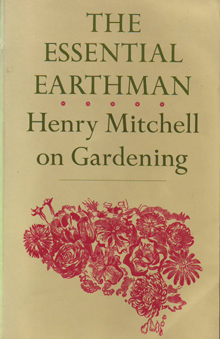
The Essential Earthman


When Carol chose The Essential Earthman for her Garden Bloggers Book Club, I was pretty sure the garden bloggers would enjoy it, but wondered what an average new gardener would think about it. Henry Mitchell started writing his garden columns in the mid-1970’s, around the time that Philo and I bought our first house. Back then, the gardeners we knew might have a basic reference book or two, but were likely to ask friends for advice or use the library to look up plants and their care. Learning how to grow things came with homeownership, stick trees abounded, and the front yards in some neighborhoods became startlingly similar, as neighbors grew and passed around divisions of the same variegated hostas, orange daylilies, phlox and iris.
If you could remember a few botanical names, liked to mail-order unusual plants and were building a collection of garden books, you became known as a ‘plant nut’, and I earned the label while gardening at our second house in the eighties. At some point, I left the ‘how-to’ books on the library shelves, taking home writers like Allen Lacy and Henry Mitchell, whose detailed observation, passion for plants and personal garden philosophy outweighed many tomes of instruction.


Twenty years later, anyone can Google, so no one needs to search through 14 or 15 books to identify a single perennial. News stories tell us that few people will wait for shrubs or trees to grow – they flip the house after a short stay. I read that half the homes in the US use a lawn service - do the owners ever learn the names of what's in their yard? How can gardeners find a personal style of gardening when they learn about gardens from television? Those instant makeover garden shows instill the personality of the TV host, not the owner.

There also seems to be an undercurrent of antagonism in horticulture news – homeowners associations attack native plant advocates, lawn afficianados & and neat freaks square off with organic gardeners, and those newly converted to ecology seldom tend their own gardens, preferring to criticize everyone else’s instead.
It appears that a garden is now an investment; a garden is now a stage on which to display wealth; a garden is now a political battlefield.

Along comes Carol, sending today's gardeners out to find The Essential Earthman. I cannot imagine Henry Mitchell looking at his lot as real estate – this man inhabits every square inch of his garden! He jams the plants in too closely, grows difficult, exotic plants from all over the world, starts trees from seed, succumbs to zone-envy, takes an entire day to get three tomatoes planted, and is overcome by the beauty of roses and iris. He speaks of the impact of a single marigold in a sea of petunias. He rejoices in small triumphs like one perfect daffodil in bloom, he putters and fusses with his stock tank, gloats over his Chinese bronze dog, and loses track of time. He encourages us not to lose heart as we deal with unpredictable weather, because “It is defiance that makes gardeners”.
I hope he will be an antidote to these depressing news stories, and that H.M.'s words will be like oxygen for those who still want genuine, experimental, personal, overreaching, messy, ridiculous gardens, not reading the pages on fast-forward, but savoring his thoughts, like this one:
... it is the Spectrum not the color, that makes color worth having, and it is the cycle, not the instant, that makes the day worth living...
Henry warns us, “ Your garden will reveal your self. Do not be terrified by that…”
I pondered those words in June as I clicked ‘Post this blog entry’ for the first time, knowing that once seen, my garden was sure to give me away, revealing my self.
I believe in Henry Mitchell’s kind of garden philosophy. His plant-specific advice, however, was written a quarter-century ago, for gardeners living far from Austin, and being under that influence got me in a bit of trouble here.
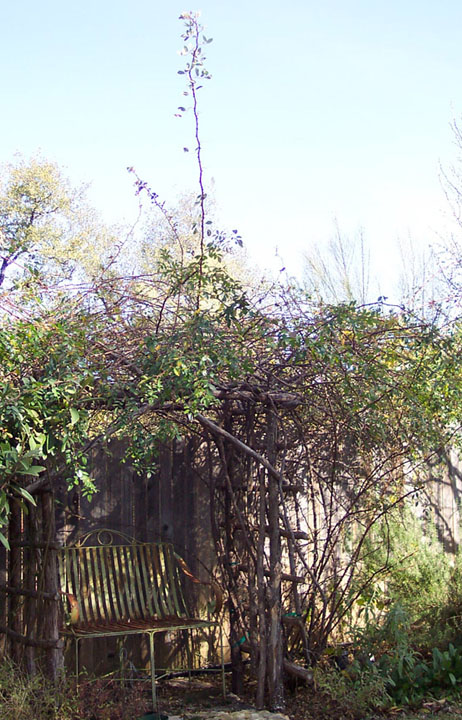
By 2000, I’d read and reread H.M.’s description of the wonderful yellow ‘Mermaid’ rose. Deer ate the roses in my own neighborhood, and I couldn’t grow any, but my friend Diane needed a climbing rose for her large new wooden arbor. I talked her into buying a ‘Mermaid’ just so I could see this rose in full glory. Henry did allow that it could be a 'large' rose, but Diane’s plant went way past “Mermaid’-size, way past ‘Manatee’ size, all the way up to Rosa ‘Orca’.


Friday, October 13, 2006

CALLING GARDEN PRODIGY


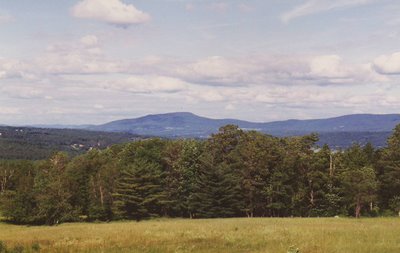
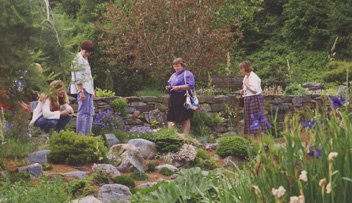
When you look at this photo the conifers might tell you that it wasn’t taken in Texas – in fact it wasn’t taken in this century. A woman named Pam snapped the shutter in June of 1993, as she looked out on the Vermont countryside from the Tearoom of the VonTrapp estate. Pam was part of a group of gardening friends who were touring New England, but not as part of a garden club or a horticulture class. Back in those pre-blogging days, they’d all met on the Prodigy garden bulletin board, where they found soulmates – other people who were obsessed with perennials, bulbs, flowering shrubs and creating personal landscapes.

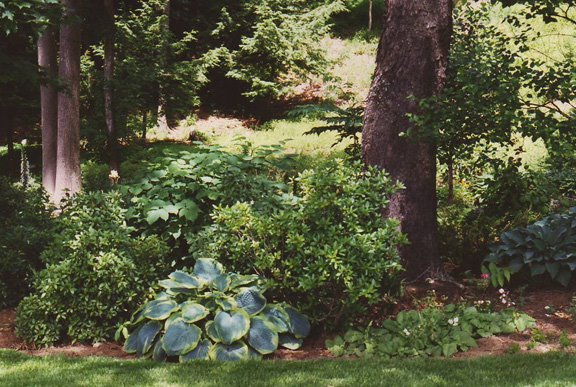
The Prodigy gardeners went to Readsboro, Vermont where these Hostas graced the grounds of North Hill. Garden authors and partners Joe Eck and Wayne Winterrowd started this garden in 1977 and thirty years later, they’re still holding open days for groups and fundraisers.

I was one of those long ago perennial maniacs, going online as Kat in N-IL whenever I had time to spare. Despite having only plain text to express our thoughts, slow response times, single phone lines with dial-up, and no way to post a photo or a drawing, it was addictive and exhilarating. Since I couldn’t meet with the others in New England, the garden at North Hill and the Von Trapp estate came to me in photos sent around the country after the trip.

This is also from Vermont - I think it's at Cady's Falls Nursery in Stowe. We never met in person so I can’t even put names to the faces, but loved their words and wonder where they are and if any of them are now garden bloggers, too.


Shout out to all you Gardeners from the Prodigy bulletin boards – Niko in Norwalk, Connecticut, Allen in Linwood, New Jersey, Marion from Waterbury, Vermont, Denise in Minnesota, Ellen & Deb from Illinois, Margaret in New York, Pam in Mechanicsburg, Pennsylvania, Bargyla in San Diego, California, Don from Saginaw, Michigan, Joyce in South Carolina, Nancy from Norcross, Georgia and all the others - I hope you’re still in the garden!