Every month Carol of
May Dreams Gardens invites us to share what's in bloom. She thought of this idea back in January of 2007 - meaning some of us are close to the end of Year Three and you've become familiar with most of our plants.
So for this third edition of November Garden Bloggers Bloom Day I decided it could be fun not only to show you what's in flower, but to show you how each plant fits into the garden as a whole. Let's wander around, following the numbers on this rough and simplified map. - it gets a little bigger if you click:

The bed near the front walk is
#1 - here's
Rosa mutabilis in bud and bloom, sending up new shoots.

A few leaves from the whitebud have fallen on a clump of Creeping phlox. It only bloomed once a year in Illinois, but decorates the edges of this bed in both spring and fall. The Yellow Bulbine is trying to take over the whole bed.

Cross the driveway to a bed anchored by three Spiraeas,
#2. I like how the pink cuphea and a fragrant mistflower mix it up - a Red Admiral butterfly approves.

The Pink Entrance Bed,
#3, has whites and purples and blues, too - like this blue-violet Duranta. Can you see that branch with different leaves? It's the 'Rumba' weigela - still alive after the summer of 2009!

There is plenty of Pink in the Pink Entrance bed, including this froth of pink Gaura backed by a fading 'Belinda's Dream' rose. This is the only open Belinda flower, but more buds are swelling.

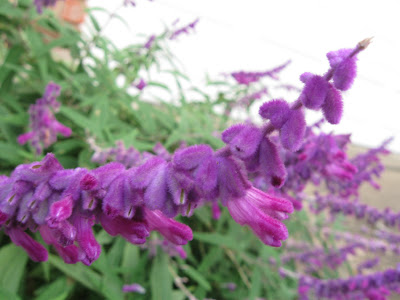
Let's go toward the Garden Gate - first passing the fuzzy purple Mexican Bush Sage at the corner of the garage,
#4, with colors even more intense than at October GBBD.
Once through the gate we're inside the privacy fence passing the NE fence border
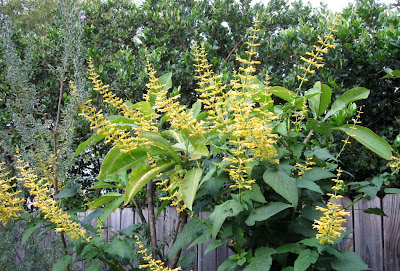
#5. Salute the
Salvia madrensis, but you'll have to look up to do it.... the wooden fence is 6-feet tall. It was just starting in October and is now in full bloom.
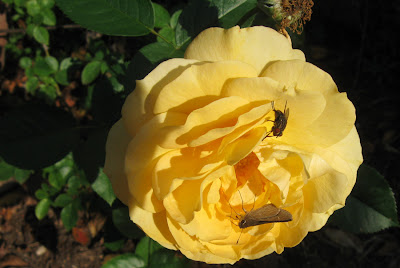
Buttery yellow 'Julia Child' rose grows in this border - also displaying only one rose today, and saving buds for later.
While we walk the grass path you'll see yellow glowing on both sides - in the triangle at right, Bed
# 6, the Mexican Mint Marigold is at its peak with
Russelia equisetiformis, Firecracker plant adding a touch of orange
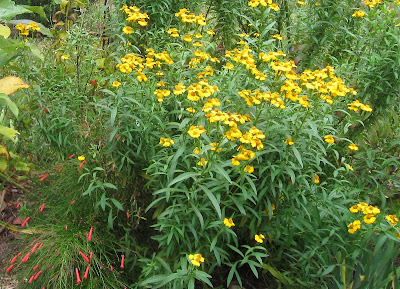
I've planted both the sunny fence border and this first triangle bed with shades of yellow & blue, with lots of white and touches of orange. I've called this Blue Butterfly flower
Clerodendrum ugandense until now-
Pam/Digging showed it with the current name,
Rotheca myricoides 'Ugandense', in a recent post. But an assortment of clunky names can't make the flower any less lovely.

On to
#7 Back in the corner of the vegetable plot is a raised planter with an old-fashioned Rose of Sharon bush and a yellow mum below. I used to hate the word 'mums', but at least I can remember it - had to look up
Dendranthema x grandiflora, Prophet Series 'Yellow". This mum was here when we moved in, still had the tag.

The other day I dug up and divided a clump of cannas, replanting some of them and setting aside the other half for my friend Ellen. Until the pecan leaves fall the vegetable garden is in dense shade so I plopped Ellen's cannas into a big pot and stuck them in the abandoned tomato plot. One of her plants had an opened bud - since they're still here this counts as
my bloom, right?

This time let's walk back between the triangle beds...the path is still "grass" now, but we have plans for granite. On the obelisk in bed
#6 the Blue Pea vine has more pods than flowers but what's there is cherce*. (*Tracy & Hepburn,
Pat & Mike)
The tropical milkweed is as pretty in bud as in bloom, and the Mexican Mint Marigold shows through the network of vines from the other side.

On the south side of the path at Triangle
#8 there's are tiny larkspur and cilantro seedlings and various annual salvia seedlings but the only flowers are on the dependable white reseeding
Zinnia linnearis. The green shrub is a dwarf Greek myrtle.

Bed
# 9 is the best spot in the whole garden, offering morning sun, afternoon shade, shelter from hail and cold north winds, access to the hose faucet and attention from the gardeners who use the back door. Currently blooming in this desirable location are the pink mouse-faced cuphea and the big Brugmansia/Angel Trumpet. The Meyer's Improved lemon ripens a handful of beautiful fruit.

Before we head for the patio a close look reveals a beautiful green spider who has captured a bee.

On the South end of the patio,
#10, impatiens bloom in one pot, Sambac Jasmine is budded in another and a potted Meyer's lemon promises Cranberry-Lemon relish for Thanksgiving.

The arch connecting the patio to the grassy area under the pecans is covered by a Coral Honeysuckle in both beautiful bloom

And delicate, graceful bud.

Cross the grass to the South fence where
#11 was designed as a hummingbird bed with lots of Salvias. Right now Gregg's salvia, Pineapple sage,
Salvia coccinea, Salvia 'Black & Blue',
Salvia guaranitica, and
Salvia farinacea each have a few flowers in red and blue, but when the
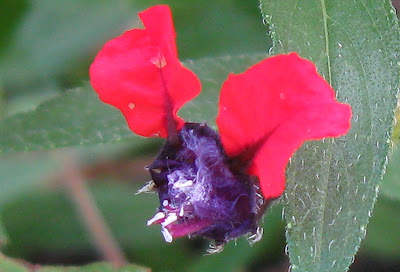
Cuphea llavea/Bat-faced cuphea combines these two colors the result is so cute it gets the photo.
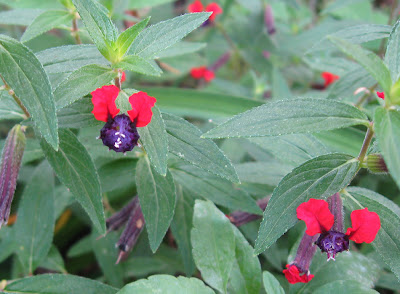
Enlarging one batface on a different photo surprised me - How old is this plant? It looks like it's growing a beard:
The hummingbird bed merges with a shady long bed as you move to the right - first bats, now toads? The Toadlily plant is half the size it was last fall, but it survived in shade and managed to push out a few spotted flowers.

As we head toward the garden shed, stop to look up at my beloved Loquat, grown from a seedling, now flowering and covered in butterflies 12-feet up in the air. The buds are just beginning to open on the lower branches.

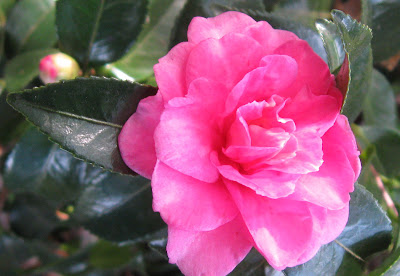
The sasanqua Camellia started blooming this week in the bed along the garden shed,
#12.
A new shrub might have died but I planted it in 2004. Being established in filtered shade meant that the camellia not only survived but made a few dozen buds and flowers. Austinites on Hill Country terrain don't usually succeed with camellias, but they're not uncommon in my part of Austin.
A few feet away is the Bulb Bed,
# 13, jammed with leftover Christmas amaryllis/Hippeastrum, with dollar store Daffodils, with non-blooming Agapanthus, old Easter lilies, freesias and other bulbs picked up on sale. One pot of
Oxalis regnellii 'Atropurpurea' , sometimes called Purple Shamrock, has been divided over and over and appears in a dozen clumps front and back. The flowers seem paler here than in real life.

Through the arch to
#14 - where more dark purple comes from a Potato vine in a blue pot, annual Impatiens act like perennials in this sheltered spot and green Oxalis bloom white.

The wooden privacy fence surrounds this little area and separates the front and back yards. I've heard this kind of space called a Dogleg, but after we cleaned out the junk we christened it the Secret Garden. When May Dreams Carol visited my garden I joked that the
secret was that I would never let the Air-Conditioner appear in any photos.

But here's the real secret of the Secret Garden: Three Sweet Olive/Osmanthus shrubs are spaced around the south end of the house, with inconspicuous flowers wafting a lovely scent over the whole back yard. A visitor might wonder where the fragrance came from, until I tell them the Secret.
The complete GBBD list with my best shot at the botanical names
will appear is now up at
Annie's Addendum.
To see more than 100 Bloom Day posts from around the world go to
Carol's roundup at May Dreams.


 Posts



 Our house was built in the late 1970's, with overhangs and a veranda to keep out the sun's heat rather than let its light shine in on leaves. Most of my plants are crowded into the bay window in the breakfast room. In a few feet of space you'll find:
 Out in the garage are 1 Mexican Lime, 3 plumerias and 1 piece of plumeria hopefully making roots, 1 more Stapelia/Starfish Flower and 1 Sambac Jasmine.
 1 Shell Ginger still has leaves in the garage - it would have died to the ground this year outside. There's 1 small rooted piece of the Angel's Trumpet Brugmansia hiding behind it, bringing us to 36 plants.
 Under the skylight in the living room there's 1 large red ceramic bowl that currently holds a ratty looking peace lily rescued from a big box home store. On the other end of the bookcase is 1 large basket of mixed houseplants... the kind you bring home after a funeral and do your best to keep alive.
 On a shelf in the bedroom there's just enough light to keep yet 1 more piece of Stapelia/Starfish flower and 1 start of Kalanchoe (also from Diva Mindy) going.
 In the guest room 3 more Thanksgiving Cactus hope for an errant sunbeam before the Arizona Ashes releaf. 43?
 In the dining room a Staghorn fern pouts and I wonder if it would do better in the cold - instead of counting to 44 I should open the door and put it out on the veranda! Wait - on the other side of the room I forgot an aspidistra/Cast iron plant that also spends time on the porch, and yet 1 more Stapelia. All the Stapelia plants are rooted pieces from a single plant my Aunt Phyll gave me about 1987 or 1988. So I guess that's 46 pots of plants, although some of them have multiple plants in one pot.
 If Mr McGregor's Daughter hadn't asked us to count our houseplants would I have noticed that this cactus turned red because its spot against the window glass was very cold in January?
 Without her idea would I have thought to not only snap a photo of the venerable original Jade Plant from the front as we see it every day....
 but also to pull out the stand and turn it around to capture the cool way the Jade branches have cascaded toward the light? Thanks MMD! The Jade plant has moved with us from house to house and from state to state, ever since we bought it at one of the greenhouses attached to Hausermann's Orchids in Villa Park, Illinois. I don't know if they sell anything but orchids now, but back in the early 197o's Hausermann's had aisles and aisles of houseplants and my sister & I especially liked to walk through and breathe the warm misty air in winter. One fine day about 1974, this Jade Plant came home with me.


