About Me
My Photo
Annie in Austin
Welcome! As "Annie in Austin" I blog about gardening in Austin, TX with occasional looks back at our former gardens in Illinois. My husband Philo & I also make videos - some use garden images as background for my original songs, some capture Austin events & sometimes we share videos of birds in our garden. Come talk about gardens, movies, music, genealogy and Austin at the Transplantable Rose and listen to my original songs on YouTube. For an overview read Three Gardens, Twenty Years. Unless noted, these words and photos are my copyrighted work.
View my complete profile
Showing posts with label Red Cascade Rose. Show all posts

Saturday, June 02, 2018

April 2018 Garden Scrapbook


April 2018 Garden Scrapbook

April Fool! Here’s what is left of that viola bowl.


The is the first time two blooms were open at the same time on these pale yellow Louisiana iris. They make a lot of leaves and take up a lot of space but are stingy with bloom.


The white eye ring makes me pretty sure this cute bird is a Nashville Warbler. They’re not here all year but they’re here for a lot of the year.


Iris and columbine – a favorite combination.


The unscented native Mock Orange (Philadelphus inodorus) was spectacular this spring, and even prettier with a swallowtail butterfly hovering.


At one time I had four clematis vines but I was not a good enough gardener to keep them alive. I’m grateful for the lovely no-name clematis that has survived.
 

This purple iris is usually the last of the bearded iris to bloom – this year it’s backed up by annual poppies and Coriander/Cilantro in bloom.


My Byzantine Gladiolus is a treasured passalong from a friend in the old part of Austin.


Against my advice, a pair of cardinals made a nest in the Lady Banks rose, two feet from the patio table, not far from the birdbath fountain. The male cardinal then attempted to chase every blue jay from the area. 


Since the Lesser Goldfinches are here all year long we sometimes take them for granted. When visitors get all excited to see them we remember how special they are. 
 

In the middle of April I saw a lone Monarch fluttering around one bed. Most of the milkweed froze and the few surviving milkweed plants were just starting to regrow. After checking out the bluebonnets the butterfly left.
  

Third week in April and the pecans are putting out leaves and pollen tassels… goodbye Sun.


After the green bowl smashed I rescued the violas and put them into a hanging basket. In the third week of April I added a hot pink calibrachoa.
 

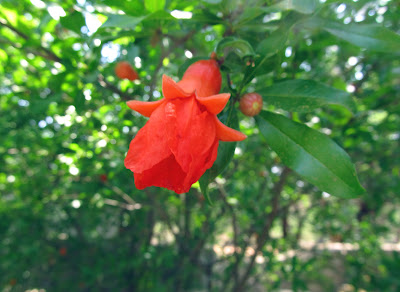
Our pomegranate tree had a lot of blooms this year. We’ve never had a single pomegranate fruit – will this be the year we do?


Larkspur reseeds every year but the number of plants keeps going down as the garden matures and the sunny spots shrink.


The climbing mini-rose is called Red Cascade and it’s a real trooper.


Tiny wildflower Venus’ Looking Glass deserves a closeup photo.


When the hard freezes came most of the developing loquat fruits dropped off the tree. Only these three loquats matured. It’s OK – while I like the fruit, I like the tree more.


This post “April 2018 Garden Scrapbook” was written by Annie in Austin for her Transplantable Rose blog.    

Saturday, April 16, 2011

Garden Bloggers Bloom Day April 2011

When we learned that family members were coming from the North to bask in the sun for a few days, the plan was for the 'Belinda's Dream', 'Mutabilis' and 'Julia Child' roses to be at their most perfect on April 10th, while still looking fabulous for GBBD on the 15th. Well, that was the plan...
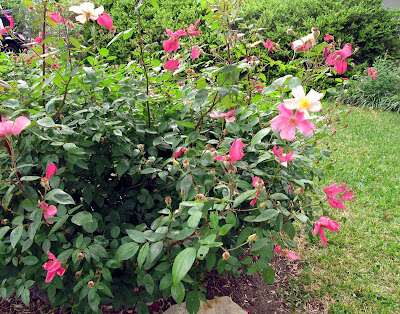

Annieinaustin, Mutabilis Rose, april'Belinda's Dream' was already an overblown beauty when our son & his dear wife arrived; 'Julia Child' still had buds and the Mutabilis rose was in full glory. But too many days with heat & dry winds made most flowers open too quickly and fall apart even faster.

Today I noticed that 'Julia Child' looks much better when seen from across the garden, veiled by larkspur. Would that work for falling-apart garden bloggers, too?


Annieinaustin,far view,larkspur,Julia Child rose
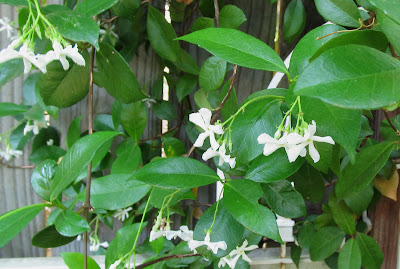
The timing was absolutely perfect for the Confederate-Star jasmine/Trachelospermum jasminoides... one plant grows near the steps of the veranda near the drive. Its fragrance is not something you can ignore so luckily our daughter-in-law liked the scent!

Annieinaustin,Confederate jasmine & rainbarrel
The fragrant yellow double Oleander didn't open its first flower until after the guests drove away Annieinaustin,double yellow oleander
The usual show of spring wildflowers along the highways has been muted somewhat by drought. Irrigating all the roadsides in Texas can't be done, but it doesn't take much water to keep a little patch happy in the garden and deadheading extends the season. Here are Blackfoot Daisies, Purple & White Annual Phlox, Texas Paintbrush & Bluebonnets, with the orchid-purple Salvia greggii in the bottom right corner. Those strappy leaves at lower left belong to the native white rainlilies - they've bloomed on and off all week but not on the 15th! Annieinaustin,paintbrush, blackfoot daisies,phlox
Here's the view from the other side of the bed - Bluebonnets and Paintbrush with the orchid-purple Salvia greggii at left. The salvia and rainlilies are perennials. The Bluebonnets are annuals - this time from seed given to me by MSS of Zanthan Gardens. The Paintbrushes can be perennial. These have been around a couple of years.
Annieinaustin,Texas paintbrush,bluebonnets,salvia greggii
My best guess on the name of the white rainlilies is Zephyranthes drummondii - or perhaps Cooperia drummondii or even Cooperia pedunculata. They grew on the hill behind our first Austin house but to see them bloom, I had to dig up a few bulbs and grow them in deck containers where the deer couldn't get them. I brought them along when we moved here so the white rainlilies now grow in garden beds. This one in the Pink garden was open for GBBD.
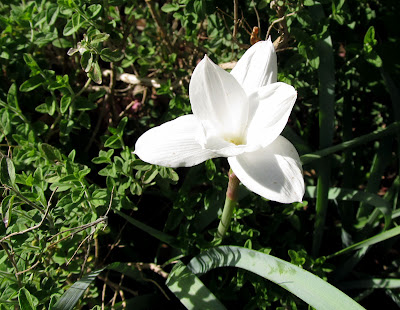
Annieinaustin,Zephyranthes drummondii
Another wildflower was timed perfectly for the visitors: Herbertia, a tiny iris relative that appears in April. Its proper name seems to be Herbertia lahue. The first plant surprised us when it popped up in the grass in 2005. A few flowers reappear each April but the numbers haven't increased. This is a native Texas plant, but it may have hitched a ride to my yard. Herbertia is reported to grow in large swaths near Houston and I've been told that when our subdivision was built in the 1970's, some of the fill soil came from East Texas. Some wildflower books call it Prairie Nymph - other books say that name belongs to a different flower. Under any name it's worth getting down to ground level for a closer look. Annieinaustin,Herbertia lahue in lawn
The gauras and salvias in the front beds are budded but not in bloom so let's go around the far side of the house where another Confederate AKA Star Jasmine blooms in the Secret Garden. (The name 'Confederate' is interesting - some references say the plant originated in Asia and the name dates from the 1890's when part of Malasia was the Federated or Confederated Malay States. But with that unsettling hint of Civil War in the name, I sometimes opt for the more neutral 'Star Jasmine'. )Annieinaustin,star jasmine on trellis
A few feet away, the pomegranate tree has a scattering of flowers and buds. This tree was labeled as variety 'Wonderful' but it's never made a single pomegranate fruit. Look how doubled and ruffled the flower is on my tree:Annieinaustin,pomegranate flower
Last weekend we took our family to Mayfield Park and the pomegranates were in bloom there. I took a photo of the Mayfield variety and noticed that the flowers are simpler and not as congested. This makes me wonder if our pomegranate's blooms are too fluffy for successful pollination.Annieinaustin,pomegranate flower, Mayfield Park
There's a delicate pink flower not far from the pomegranate in the secret garden - an Indigofera/Pink False Indigo. This plant has a reputation for being a spreader, but in 5 seasons here it's behaved well, tucked in with native ferns and Cast Iron Plant:

Annieinaustin,Pink false indigoAlso in the Secret Garden is the Blue Sky vine from the March GBBD post. The plant was already budded and in bloom when I bought it but now it's down to the last blossom. The vine itself is growing like mad and has reached the top of the arch - maybe there will be more flowers on the new growth?
Annieinaustin,last flower on Blue Sky Vine
Through the arch and over to the bed where a bright coral, unlabeled mini-rose planted by some previous owner is in bloom. We've added bulbs like Iphieon/Star Flower, Oxalis and Hippeastrum, the familiar holiday Amaryllis, which can survive outside in Austin. Annieinaustin,coral mini-rose & amaryllis
Also in the bed are other flowers with flowers in the orange/coral range - a few plants of Mountain sage/Salvia regla that will bloom in fall and this native columbine:
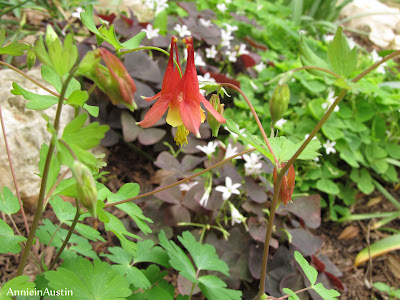
Annieinaustin,columbine with oxalis
We made a small bed for a 'Pride of Houston' yaupon under the canopy of the back pecan in 2009. That small bed turned into a new long border in early 2010 and most of the young plants are doing well. Cedar sage/Salvia roemeriana grows at the high end of the bed near the original yaupon and it looks pretty happy. Annieinaustin,Salvia roemeriana in my garden

Then last week we all went to McKinney Falls state park and for the first time I saw Cedar Sage in its natural environment of hill & rocks in an oak forest. Now my Cedar Sage is demanding a dramatic stone backdrop, too. Annieinaustin,Salvia roemeriana at McKinney Falls

The Oakleaf Hydrangea has produced five large flowerheads. Behind the Hydrangea is Ageratina havanensis, a native fragrant white mist flower, and it's making buds! I'm not sure what's going on -we have two more of these mistflowers in front but they've never bloomed in spring - just in fall. Annieinaustin,Oakleaf Hydrangea flower

The front edge of this long bed is in sun - here are Four-nerve daisies, Bluebonnets, Creeping phlox, larkspur, Louisiana iris and Siberian iris
Annieinaustin,Blues & Yellows, april garden

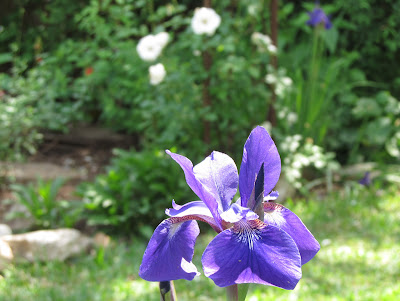
In the background below you can make out a white 'Climbing Iceberg' rose and the original plant of a passalong Siberian iris. A small piece of the iris came from Chicago back in 2005. The small piece took years to become a clump and was finally large enough to divide last year when we made the new bed. Siberian iris sometimes take a while to settle in, so it was a pleasant surprise to get flowers on the new division this spring! Annieinaustin,Siberian iris flower
Near the birdbath fountain the 1-year old 'Red Cascade' climbing miniature rose is in bloom, its pure red color looking good against the Lueders stone.Annieinaustin,Red Cascade climbing mini-rose

The clematis known as 'Starts-out-ruby-red-then-fades-to-reddish-purple' is in full bloom now - a good surprise. The tangle of vines had become so buggy and moldy that in late winter I cut it down almost to the ground, carefully removing every leaf and washing the trellis. The plant sent out new shoots to cover the trellis by the end of March and the first flower opened the day our family arrived. Annieinaustin,reddish purple clematis
Late on Friday afternoon one flower on the 'Little Gem' magnolia swelled to open... but so high up that the zoom couldn't get a good viewAnnieinaustin,Little Gem magnolia budAnd finally, here is my contribution to the Odd Poppy posts from Austin Garden Bloggers (Robin Getting Grounded, Rock Rose Jenny, MSS of Zanthan Gardens) who all experienced unexpected results when they grew Frilly Pink Poppies from seed. Scattering poppy seed hasn't worked for me, so I bought a few started plants from the Natural Gardener on March 6th. The only color I could find was labeled 'Maroon'. A few days ago they looked like this: Annieinaustin,Annieinaustin, maroon poppies
But soon after the other bloggers mentioned frilly pink poppies one appeared in my garden... maybe a stray seed in with the maroon plant? Annieinaustin,maroon & pink poppiesThis one's a bit salmon-pink but it should be good enough to get me in the Frilly Pink Poppy club!Annieinaustin,frilly peach-pink poppy
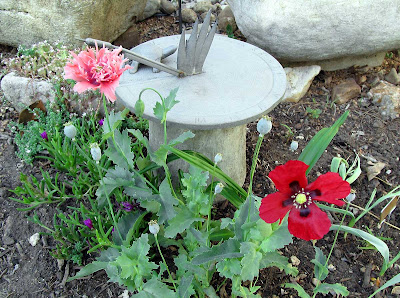
As you can see we're long past tulip & daffodil season here in Texas - to see those traditional spring favorites and to check out what's blooming all over the world go to Carol's round up over at May Dreams Gardens. , the Garden Blogger Bloom Day headquarters.

For more about Mayfield Park, see Carolyn's Caroline's delightful tour of Mayfield Park on her blog, The Shovel Ready Garden. We fell in love with this garden museum more than a decade ago - maybe you will, too.

For the complete April list of blooms with my best guess at botanical names, please go to Annie's Addendum.
Monday, November 15, 2010

Garden Bloggers Bloom Day for November 2010

The monthly recording by Garden Bloggers of what's in bloom in our yards was started by May Dreams Carol in February 2007. It became an instant tradition, letting us share our garden flowers while acting as a useful tool to keep track of how the plants we grow act in different years.

Many dependable plants will make a fourth appearance in this November GBBD post. But there are downsides to keeping records... a glance back shows what is not here - cold January 2010 weather killed the Duranta, defeated the Confederate Rose and disappeared every bit of the yellow bulbine, a plant that had grown so exuberantly in 2009 it was thinned and divisions were given away.

With records to tell me what to expect, should I now feel cheated because the usual November bloomers didn't flower? Woe, woe, for the spindly Passion vine, the struggling Brugmansia and what remains of the Toad lily! The roses are 'resting' and the Sweet Olives are off schedule. There is not one Meyer's lemon for Thanksgiving cranberry relish? No fair!

Annieinaustin, Meyer lemons for relish

Enough of the whining - one advantage of being a plantaholic is that no matter how many plants bail on bloom day - something will have flowers:

It's ironic to see the Camellia 'Shishi Gashira', beautifully budded and with glossy foliage after a year that knocked off plants more suited to Central Texas.

Annieinaustin, Camellia Shishi Gashira
The Loquat tree is also well-budded, now opening the first flowers - so even without the Sweet Olive's fragrance, November smells sweet.Annieinaustin, loquat buds
Just a breeze across the leaves can make the Pineapple sage release scent, too. One plant grows in the Hummingbird bed.. this one is near the Blue Butterfly Clerodendron on the patio. Pineapple sage seldom lives through winter but it's usually easy to find starts in spring. Replacements for blue Clerodendron are hard to find and expensive. After helping me find this large potted Blue Butterfly, Robin told me that cuttings root easily. I've taken her advice and have rooted a few pieces to grow indoors as insurance that blue butterflies will float over my garden next year. Annieinaustin, Pineapple sage and Blue Butterfly Clerodendron

Salvia regla would prefer life on a rocky hillside in the Chisos Mountains of Big Bend, but it survived the 12" deluge from Hermine in September and has been popping orange flowers for weeks. Most sites call it a shrub, but it freezes back so hard in my garden that it never attains much size.
Annieinaustin, Salvia regla, mountain sage

More orange and yellow come from Tropical Milkweed/Asclepias curassavica and Mexican Mint Marigold. The milkweed doesn't always survive winter but usually reseeds somewhere nearby. The Mexican Mint marigold/Tagetes lucida, has been perennial in my garden since 2004.

Annieinaustin, Mexican Mint Marigold & Tropical Milkweed
A paler yellow color comes from the Salvia madrensis/Forsythia sage, seen here leaning onto the Mexican Honeysuckle/Justicia spicigeraAnnieinaustin, Salvia madrensis

I've grown Moon Flower vine/Ipomoea alba for decades but don't remember buds and flowers in mid-November - they look defiant against yesterday's grey afternoon sky
Annieinaustin, Moonflower vine bud in November

Because two plants of Ageratina havanensis survive & bloom in the front yard, a third plant of the native fragrant mistflower went into the yaupon bed this spring, mingling with Salvia vanhouttei. The salvia is pretty tender but the mistflower should return.Annieinaustin, Ageratina havanensis
The pink gaura looked horrible in late summer... a severe pruning and cooler weather produced intensely colored flowersAnnieinAustin, Rose pink gaura
The pot of 'Provence' lavender started blooming in May and hasn't given up. Neither has the Evolvolus 'Blue Daze'. These plants don't do well when planted in my clay soil but they can do well in containersAnnieinaustin, lavender and Blue daze evolvolus

If we can avoid a freeze for a few more weeks, these tiny peppers might make it to the kitchen. Annieinaustin, peppers in November
All the above blooms have made previous November appearances - but this is the first November for some new plants.

'Marilyn's Choice' Abutilon was a 1-ft tall rooted cutting when I planted in the new yaupon bed last spring. It made a few flowers, then turned to branching and growing into a gawky shrub. This abutilon looked like a big weed all summer, not reblooming until now. The flowers are not thrilling me but watching them develop is interesting. Annieinaustin, Marilyn's Choice abutilonI planted another plant in the mallow family, Pam's Pink Turkscap/Malvaviscus 'Pam Puryear' in the same bed. It also grew into a large, gawky, branched plant that looked like a weed as summer waned. It had a few pink flowers at the beginning of November but they're gone for GBBD.

After planting the 'Marilyn's Choice', I hedged my bets by moving the other small abutilon into a container so at least one of them could be taken in or covered in cold weather. The second abutilon was just called 'Patrick's', but Linda of the Central Texas Gardener TV show let me know it's named after Central Texas garden designer Patrick Kirwin. This plant never branched but steadily produced one lovely flower at a time on an ever-taller stalk. Annieinaustin, Patrick Kirwin abutilon

The Shrimp plant/Justicia brandegeana was planted in late spring. It opened a few flowers, then looked stressed. Apparently what it wanted was relocation! Instead of trusting the gardener to catch on the Shrimp plant grew an elongated stalk, leaned that stalk onto the ground, rooted it at the end and sent up a healthier plant 2-feet away from the spot I'd chosen. The flowers do look like seafood, don't they?Annieinaustin, Shrimp plant
Lion's Tail is another new plant that resented being planted this year, not growing at all for months. After Hermine is perked up, grew steadily and now has buds. But we're getting close to average frost date and it's only borderline hardy in my part of Austin - any bets on whether these buds will open before the plant freezes?

A final November bow by a newcomer is made by the miniature climbing rose 'Red Cascade' rose, described as a miniature climbing rose. It wasn't planted until midsummer and I don't know how it will do longterm, but how good it is to see in bloom on this November day. Annieinaustin, Red Cascade climbing miniature rose


For a bloom-tour around the world go to Carol's November GBBD Roundup.

For my list of everything that has a flower, with my best tries at botanical names, go to Annie's Addendum