
About Me
My Photo
Annie in Austin
Welcome! As "Annie in Austin" I blog about gardening in Austin, TX with occasional looks back at our former gardens in Illinois. My husband Philo & I also make videos - some use garden images as background for my original songs, some capture Austin events & sometimes we share videos of birds in our garden. Come talk about gardens, movies, music, genealogy and Austin at the Transplantable Rose and listen to my original songs on YouTube. For an overview read Three Gardens, Twenty Years. Unless noted, these words and photos are my copyrighted work.
View my complete profile
Showing posts with label Illinois. Show all posts

Wednesday, February 03, 2010

The Great Houseplant Census of 2010

Mr McGregor's Daughter has suggested a mid-winter diversion - to number and share the houseplants currently in captivity in our dwellings. I'm granting myself a lot of permissions here - #1 is permission to be late! #2 is to count anything that's within the walls for the winter, including some stuff in the garage. #3 is to call everything by its common name instead of trying to hunt down the botanical one.

Our house was built in the late 1970's, with overhangs and a veranda to keep out the sun's heat rather than let its light shine in on leaves. Most of my plants are crowded into the bay window in the breakfast room. In a few feet of space you'll find:
2 water-filled bottles with rooting pieces from an ornamental chartreuse potato vines
1 small cactus from my niece some years ago
2 pots filled with Alligator Plant/Mother of Thousands from DivaAnnie
1 Thanksgiving cactus
1 Thai lime
2 Jade Plants
1 half-dead Pothos
1 Allspice plant - found on an expedition with MSS
1 cyclamen in full bloom
1 Meyer's Lemon tree
2 stapelia plants
1 amaryllis just finishing bloom
3 amaryllis not yet waked up
2 rooted cuttings of Cuban Oregano and
1 rooted cutting of some kind of succulent from Diva Mindy (think she said Donkey's Ears?)
1 badly-treated bonsai fig won in a drawing years ago and
1 salmon geranium that saves many a bloom day.
1 Haworthia does well here -
2 others are not so happy in the nearby laundry room window. Think that adds up to 27 in the kitchen area.


Out in the garage are 1 Mexican Lime, 3 plumerias and 1 piece of plumeria hopefully making roots, 1 more Stapelia/Starfish Flower and 1 Sambac Jasmine.

1 Shell Ginger still has leaves in the garage - it would have died to the ground this year outside. There's 1 small rooted piece of the Angel's Trumpet Brugmansia hiding behind it, bringing us to 36 plants.

Under the skylight in the living room there's 1 large red ceramic bowl that currently holds a ratty looking peace lily rescued from a big box home store. On the other end of the bookcase is 1 large basket of mixed houseplants... the kind you bring home after a funeral and do your best to keep alive.

On a shelf in the bedroom there's just enough light to keep yet 1 more piece of Stapelia/Starfish flower and 1 start of Kalanchoe (also from Diva Mindy) going.

In the guest room 3 more Thanksgiving Cactus hope for an errant sunbeam before the Arizona Ashes releaf. 43?

In the dining room a Staghorn fern pouts and I wonder if it would do better in the cold - instead of counting to 44 I should open the door and put it out on the veranda! Wait - on the other side of the room I forgot an aspidistra/Cast iron plant that also spends time on the porch, and yet 1 more Stapelia. All the Stapelia plants are rooted pieces from a single plant my Aunt Phyll gave me about 1987 or 1988. So I guess that's 46 pots of plants, although some of them have multiple plants in one pot.


If Mr McGregor's Daughter hadn't asked us to count our houseplants would I have noticed that this cactus turned red because its spot against the window glass was very cold in January?

Without her idea would I have thought to not only snap a photo of the venerable original Jade Plant from the front as we see it every day....

but also to pull out the stand and turn it around to capture the cool way the Jade branches have cascaded toward the light? Thanks MMD! The Jade plant has moved with us from house to house and from state to state, ever since we bought it at one of the greenhouses attached to Hausermann's Orchids in Villa Park, Illinois. I don't know if they sell anything but orchids now, but back in the early 197o's Hausermann's had aisles and aisles of houseplants and my sister & I especially liked to walk through and breathe the warm misty air in winter. One fine day about 1974, this Jade Plant came home with me.

Wednesday, May 06, 2009

Thought Pops, Edition 6: Roofs, Roots, Retrospection and Lavender

THE NEW ROOF
The Hail-damaged roof is gone and the new one seems to suit our cottage very well! I had been dreading the process, fearful for the many, many plants both in the ground and in containers on all sides of the house. Then someone in our extended family recommended Mitchell Construction. In addition to the way the roof itself was done, I was pleased that the company treated my concerns seriously and the way all the hard-working people involved avoided damage to the garden. Attention to detail and care with picking up every bit of debris made it much more pleasant than a previous roofing experience. When the work was finished Alan Barber asked Philo to climb on the roof with him to survey the new shingles. From this angle you can see the stacks painted to blend with roof - a nice touch.


ROOTS

For the last week I've been on a genealogy bender, ever since my friend Ruth recommended that I give the Pilot Search feature at FamilySearch.org a look. I've used the site before, but hadn't tried that particular search engine. Just about every name on my lists was plugged in and many records appeared that I hadn't seen before. One part of the family tree used to stop with Kunigunda but not any more! It was amusing but not surprising that my great-great-great grandparents turned out to be 'Joseph' and 'Elizabeth'... those names appear over and over through the generations.

A WHOLE DECADE
Ten years ago today, I snapped the garden photo above, then my youngest son & I drove to O'Hare Airport in Chicago, flying to the old Mueller Airport during its last days of operation. We got off the plane, met Philo, and took our first look at our future hometown of Austin, Texas. Philo had been working here for a few months, commuting back and forth to Illinois so this was his chance to show us around the new territory. We drove through likely neighborhoods, walked around downtown and saw 6th Street, checked out the University area, drove along the scenic Capital of Texas highway over the Pennybacker Bridge, ate at The Old Pecan Street Cafe and became acquainted with Taco Cabana. We returned to Illinois, then a month later we flew into the brand-new Austin-Bergstrom International Airport and went househunting. These flowers opened today on a daylily called 'Vi's Apricot', a plant that was happy in our llinois garden. We brought it along with us, to bloom and grow in Texas. The original deal was we'd stay 3 years. We're all still here.

LAVENDER STICKS
This year a couple of Sweet Lavender plants lived over winter, then made enough long stems to make a sweet and simple Lavender Stick as described by Elizabeth Lawrence in Through The Garden Gate. You can find step-by-step instructions at my other blog, Annie's Addendum. A lot of stuff seems to end up over there lately! You might also enjoy old Illinois iris lists or the photo of a Cactus with daffodils.

Thursday, October 04, 2007

Autumn Wears Her Red Dress

We're still enjoying temperatures in the nineties each day, but the plants show signs that it is fall. One proof - the hummingbird garden has gone completely Red.
Tall white hardy Hibiscus, Shasta daisies and blue salvias dominate this area from May to September. I saw a few Texas Star Hibiscus flowers in summer along with the off-and-on red of the short-lived Hummingbird sage - probably Salvia coccinea. It blooms, sets seed, the original plant dies, and another pops up nearby.
The largest red-bloomer hasn't done much since last fall, but look what's happened to the Pineapple sage, Salvia elegans in the last few days:

Its flowers appear when the days and nights are close in length. This can happen in a mild spring when the plant is not frozen back, but is more usual in fall. Most salvias are useful in deer-resistent gardens, but not our deliciously-scented Pineapple Sage! We kept it in deck containers at our previous house.


The Chili pequin [Capsicum annuum, according to the Wildflower Center] still has lots of tiny peppers. Philo hasn't tried it yet, but one of the Divas told me her husband Warren pickles large quantities of the fiery little fruit each year.


Autumn wears a purple hat with her red dress in the photo above. 'Bat-faced' Cuphea llaevea has produced red/purple flowers since early summer.

A few purple berries remain uneaten by mockingbirds on the Callicarpa americana/Beautyberry below.


My attempts to make vines bloom in a crepe myrtle has had mixed results - no new Passionflowers to photograph, and the Hyacinth bean/Dolichos lab-lab is all pods now, dangling ten feet up in the tree.
One of the surest signs of autumn in my garden is the flowering of Barleria cristata, the Philippine Violet. Some sites say this is a native of India, not the Philippines, and not in the violet family, but belonging to Acanthus.The plant below started out as a 3-inch rooted cutting in March, and it's now about two-feet tall in partial shade. The flowering seems to be triggered by the shortening of the days as the Autumnal Equinox approaches.


Those of who garden in the Northern Hemisphere celebrated the autumnal equinox on September 23rd-- and now our blogs record and share what happens as fall arrives. It might mean cooler, shorter days, changing leaves and that slanting, autumn light.

In my mind the term autumnal equinox meant that the days and nights were of equal length, so it surprised me when Philo pointed out that here in Austin, our day & night actually became equal on the 27th, and our descent into winter didn't really begin until the 28th.

I'd already noticed the startling variation in the longest days of summer for the different places friends and family lived - just one of those things that color our individual relationship with our spot on the globe. Philo used Naval Observatory tables to chart a few US cities for me, arranged by latitude, North to South, so we can see how things change as you move toward the equator. He adjusted to Daylight time for summer and this data is for 2007.

This may be the point where you jump ship, but I enjoy mildly geeky statistics and bet some of you do, too:

The days and nights in Anchorage, Alaska reached equal length on September 25th. Seattle, Washington also had equal days and nights on September 25th.

San Francisco, California took another day to even up its days and nights as did

Chicago, Illinois - both had equal days and nights on the 26th.
Austin, Texas and Miami, Florida waited until September 27th.

Kona, Hawaii was a day later than the others, on the 28th.


That's pretty interesting, but this is the part that really gets me - day length variation:


In Anchorage [latitude N61º 13'] on the shortest day in winter, the sun rises at 10:14 AM and sets at 3:41 PM. On the longest day in summer, the sun rises at 4:20 in the morning, and stays up until 11:42 PM - so the difference in the shortest day and longest day is a whopping 13 hours and 55 minutes.


Seattle [latitude N47º 38'] sees sunrise on the shortest day of winter at 7:55 AM, with sunset at 4:20 in the afternoon; go to the opposite season and the sun rises at 5:11 in the morning, setting at 9:11 at night... what a nice long day for gardening, and the glow at twilight makes it seem even longer. Seattle has a difference of 7 hours 35 minutes between the longest and shortest days.

Chicago [latitude N41º 51'] has a 6 hour, 6 minute variation from longest to shortest days, with winter sunrise at 7:15 AM, winter sunset 4:23 PM, summer sunrise 5:16 AM, summer sunset 8:30 PM.


San Francisco [latitude N37º 46'] comes next, with a 5 hour, 14 minute variation from summer to winter; the sun rises at the winter solstice at 7:21 AM, sets at 4:54 PM. The sun rises on the longest day at 5:48 AM and sets at 8:35 PM that evening.

Day length in Austin [latitude N30º 17'] varies only 3 hours and 54 minutes from shortest day of winter to longest day of summer. Our winter sun rises at 7:23 in the morning, setting at 5:35 that night, not so bad for school buses. At the summer solstice, the sun rises at 6:29 AM, setting at 8:36.


Miami [latitude N25º 47'] daylength varies even less - only 3 hours and 13 minutes separate longest and shortest days. The sun comes up at 7:03 AM in winter, setting at 5:35 PM on the winter solstice. In summer the sun appears only a half-hour earlier, rising at 6:30 AM and setting at 8:15 PM.


If you're in the city of Kona, on the Big Island of Hawaii, [latitude N21º 19'] there isn't a lot of difference in winter and summer: only 2 hours and 36 minutes. This part of Hawaii has sunrise on the shortest day at 7: 04 AM, and the sun sets at 5:55 PM. The sun will rise only a quarter of an hour earlier on the longest day, at 6:50 AM, and the residents will get the extra 2+ hours at the end of their longest day - with sunset at 8:16 PM.


While these numbers were interesting in themselves, since we read blogs by people who garden in different places we might think about how day length affects humans and their gardens.


Back in Illinois the crows started cawing as the sun began to glow - waking us at 5 in the morning. Northern friends could rise early and fit in an hour on a vegetable plot before dressing for work. When we moved to Austin it was a surprise when it was still quite dark at 6 AM in midsummer, and we were often awake before the birds made a sound. [It was also a surprise to see Turkey vultures rather than crows!]


The people in the North get earlier frosts and shorter summers, but they also get used to having many more hours of daylight during the summer. Kona, Hawaii may miss out on the pleasant glow of long summer evenings, but those folks won't need headlights at 4 PM in December.

Do you think the variation in your shortest and longest daylength affects you?

Monday, July 16, 2007

Three Gardens - Twenty Years

Sometimes I confuse people, especially new readers, by bouncing from past to present, first talking about the house we live in now, then switching to a past garden in either Texas or Illinois. I thought you might like a post with dates and descriptions of the last three places.

ILLINOIS
The Former Illinois Garden [1987-1999] was a 60' wide X 300' long rectangle on flat land in the Western Suburbs of Chicago. We'd spent years playing in the dirt at other houses by the time we moved there in spring 1987.
We lived at this house for 12 years, long enough to make a large front garden with mixed borders of flowering trees, shrubs, dwarf evergreens, perennials, bulbs, and annuals surrounding an amoeba-shaped central lawn. The photo above is from late summer, and that's the same birdbath you see in current photos! This garden was enclosed by a low fence with roses and vines growing on it, with a 'hot' border along the driveway.
The photo above was taken on an April day in the mid-1990's. By then I'd spent time at Trudi Temple's Hinsdale garden . Her deep, curving borders had a big influence on my style, and Ann Lovejoy gave this style a name: The American Mixed Border. Gardens in the back included a Square Sitting Garden off the patio, vegetable beds, patches of both red raspberries and black raspberries, fruit trees, native woodland borders and shrub borders. There were also lots of lilacs, tulips, peonies, daffodils, iris, daylilies, oriental lilies, clematis and hostas!

TEXAS ONE
The First Austin House, sometimes referred to as our first House in Texas [1999-2004] had just a few saplings and some overgrown foundation junipers in the flat front yard when we moved there in late summer 1999. The sides and back yard were a steep, rocky canyon covered by decks.
I took a few classes in Hill Country Gardening, realizing that Midwest experience was not always useful here. Deer nibbled everything, so we planted a deer-resistant, drought-tolerant landscape in the front. In the photo above there are santolinas, artemesias, Salvias greggii, leucantha and 'Indigo Spires', various lantana, dwarf yaupon, Vitex, Texas Mountain Laurels and Copper Canyon daisies.Gates kept the deer out of the SW-facing Deck Garden in back. We experimented with all kinds of trees, shrubs, perennials, annuals, vines and bulbs, enchanted with the sub-tropical plants that don't grow in Illinois. That's my beloved Loquat in the photo above, still a sapling tree next to the brick column.

Above left is an 'Acoma' Crepe myrtle in 2003, barely surviving and seldom blooming in the container. The lavender at center did fine on the deck, along with the Pineapple sage, Indian Hawthorn, Oleander, Dianthus and oregano. Once we learned that deer eat native wildflowers like Bluebonnets and Indian Paintbrush, we grew them in pots on the deck, too.
We lived at this first Austin house for 5 years, enjoying the views from the decks. Above are the Lady Banks rose and Confederate Jasmine waving wands of yellow flowers over the deck rail from their container.

TEXAS TWO
At the end of July 2004 we moved to our current Austin Garden in a wooded neighborhood built in the late 1970's.With help from our family, we hauled the one hundred containers [and that birdbath] to this gently sloping, trapezoid-shaped yard with our first-ever privacy fence. It took a couple of years to get the Loquat, Camellia, Cenizo, Indian Hawthorne, Crepe Myrtle, Sweet Olive, Beautyberry, Fig and Boxwood out of containers and into Texas soil. The two 'Acoma' crepe myrtles have been trained into trees and are finally higher than the privacy fence.

We once knew something about Illinois gardening, and then learned something about gardening in rocky, hilly Austin deer country, but we had to relearn gardening once again. Although our present garden is less than two miles from Austin house # one, instead of a blank rectangle of rocky caliche, we're dealing with heavy clay soil inhabited by dozens of existing trees.
We're still learning.

Friday, June 08, 2007

Passalong Plants - The Daylilies

Last fall the Austin Garden Bloggers met, and PAM from Digging brought me a division of this daylily, “Best of Friends”. You’ve probably seen Pam’s May 23rd post, filled with buds and blossoms of this beautiful daylily. I’m thrilled to see it flower in my garden. ‘Best of Friends’ is the newest of my passalong daylilies, treasured both for the beauty of the flowers, and the friends who passed them along.

Above is the passalong apricot daylily seen in the May 15th post and still unfolding flowers every morning. It was one of a group of unnamed ‘Stella d’Oro’ descendents, seedlings that were sold like living raffle tickets for a few dollars back in the early 1990’s at house #3. My friends and I bought a few, and waited for them to bloom. Some turned out pretty, some looked almost like the ubiquitous ‘Stella’ herself, and some were pitiful. My friend VIOLA was pleased to get a nice apricot form, and when it increased after a few years, she gave me a start. I grew it in Illinois, dubbing it ‘Vi’s Apricot’, and carried it to Austin. It’s quite a small flower, as you can see below when a bloom from ‘Vi’s Apricot’ is tucked in next to the large flower of ‘Best of Friends’.

Vi is retired from gardening now, but at one time she was very active in her Illinois Garden Club, donating time and labor toward community issues while enjoying the social aspects of the club. Visitors loved her enormous perennial borders, jammed with plants collected over the decades. Vi would guide the visitors around the garden, trowel in hand, ready to send a friend home with a living token of their tour.


More than a decade ago I bought this small maroon daylily as a gift for Vi. She was delighted to find out that Hemerocallis ‘Pinocchio’ could produce a second flush of bloom. Once the plant grew large enough, Vi insisted on passing a fan of it back to me and ‘Pinocchio’ also came with when we left for Texas.
.
Thirty years ago, as a just-moved young gardener at house #2, I met BERTHA. My new neighbor was a retired businesswoman in her early seventies who volunteered her clear, cultivated speaking voice to record technical books for the blind. Bertha grew flowers that had come from her own mother’s garden, and she shared one of her mother’s daylilies with me.


I’ve grown it in four of my gardens, and remember my friend fondly but I can’t call it ‘Bertha’s Yellow’ – this one already had a name, Hemerocallis citrina. Here’s the second bloom of 2007 on this tall, light yellow daylily, which opens in early evening and has a faint but pleasing scent. It stays open overnight, closing as the sun comes up.


Of the nearly 50 daylilies that I grew in Illinois, only 6 made the cut and traveled to Texas. Two came from nurseries- four were Passalongs.

I brought Vi's ‘Pinocchio’, ‘Vi’s Apricot’, Bertha's Hemerocallis citrina, the purchased ‘Prairie Blue Eyes’ [blooming in the photo above], a purchased ‘Catherine Woodbury’ and a passalong ‘Eenie Allegro’ from Vi. These daylilies had a rough life, spending 5 years confined in deck containers. I nearly lost them all at one time or another, and both ‘Catherine’ and ‘Eenie’ succumbed to the intense heat. The four survivors are doing better since 2005, when they finally traded life in pots for roots in Austin clay.
They've grown and if this summer lets them continue to thrive, these daylilies are ready to become Passalong plants once again. I think that both Vi and Bertha would be pleased and perhaps amused, to know that their daylilies were growing and being handed around deep in the heart of Texas.
In a few weeks I'd like to tell you about some plants that were passed along by other Austin gardeners. Until I get back from Illinois - Happy Gardening to all of you!
[This post was begun May 31, but completed, photos added and posted June 8th.]

Wednesday, May 23, 2007

Carolus and the Clerk


This photo was taken in 1988, at the Chicago Botanical Garden in Glencoe. I haven't been there in some time, and don't know how it looks today, but back then my younger children loved the intricate details and large three-dimensional quality of this portrait of Carolus Linnaeus. On every visit, and there were many, we walked around it, trying to identify the individual leaves and flowers that were sculpted and blended together to form his image. Today, the 300th birth anniversary of Linnaeus is being celebrated not only in Sweden, but in the hearts of gardeners and scientists all over the world.

This day is also the birthday of a modern gardener, the wonderful, intricate and three-dimensional Hank the County Clerk - if you have a chance to read some of his essays on Linnaeus [make that essays that use Linnaeus as the jumping-off point for many thoughts!] you will be amazed. Here's a link to Linnaeus, Son of No Man.

Happy Birthday, Hank... and Carolus, we do not forget you.

Thursday, March 22, 2007

Iris, A Meme and Nostalgia

The County Clerk asked for more iris photos – remember the mystery iris that had been labeled purple? It opened and looks exactly like the big clump of pale orange ones, which had also been labeled as purple. There must be a colorblind organic gardener supplying these mismarked divisions to the fundraising sales!

Here is one of the pale orange ones at left, cut from its stalk and held in my hand. The mystery iris is at right… they look identical to me.

The County Clerk also tagged me for a même, so I gave it a try.


1] I’ve spent months researching the perfect tree or shrub for some area we’re revamping, then dragged Philo from nursery to nursery hunting for it. Several times we brought our treasure home and set the container in the designated place, but… there were no bells, no skyrockets, no tingles of delight. I set the poor reject aside for some other use, and went back to the research.

2] I can trap myself into doing projects by using psychology. Trudi Temple has a wonderful garden in Illinois, which I visited over and over back in the nineties. The first time I went to Trudi’s, I came home wanting to emulate her, but knew I’d have second thoughts if I waited too long. I knew exactly what amount of destruction would keep me from turning back, and before going in to cook dinner, had ripped out a band of grass wide enough to delineate the boundaries of a new huge front yard border. When I wanted a new side garden this spring, I used a weed whip to scribe the basic shape, destroying the turf so I wouldn’t chicken out. [This border is coming along and there will be photos in a few weeks.]

3] I didn’t even realize this might be considered crazy, but Philo recalled how puzzled the old neighbors were when I used our children’s wagons and carts to roll trees and shrubs around the yard. I would move them to possible locations, sometimes leaving them in place for a week or two before making final planting decisions. The neighbors may also have been amused when I persuaded family members of differing heights into letting me position them with arms stretched outward overhead, then maneuvered them around the yard so I could estimate how a tree or shrub would look in the landscape.

4] Maybe this one really was crazy. When my mother-in-law gave me money as a birthday gift, she probably hoped I’d get my hair restyled, or at least buy some new clothes. I took the money to the material supply yard instead, and bought boulders for my garden.


5] I may never know if this was the craziest thing I’ve ever done or if it was the sanest. Eight years ago I let myself be talked into leaving our families, our home and the tree peony, the iris, the lilies, the Pagoda Dogwood, the wildflowers, the lilacs and so much more that grew in our 12-year old garden in Illinois, in order to live in Texas.


We thought it would last 3-to-5 years, and there were many good reasons to move, both professional and financial. But I must confess that there was an element of horticultural greed influencing my consent. I wanted a chance to grow the plants in the Plant Delight Catalog…all those plants from warmer zones. Well, I'm plenty warm now.


Friday noon: Carol's question about the vines on our Illinois garage roof sent me to the photo albums. Maybe this should be crazy thing # 6? I talked Philo into putting a lathe and chicken wire stripe from side to side, over the roof point. A long-established Sweet Autumn Clematis climbed up from the left, blue morning glories grew quickly on the right, and they swirled together by August. The open garage door and basketball net don't do too much for the photo, but it was pretty cool to see in person!
Annie

Many of you are swamped with spring cleanup, so I hesitate to tag anyone. If you read this, and would like to do the meme, please go to the County Clerk's site and find out how to make a post. Those of you who are whining that you can't be out in the garden right now, consider yourself tagged!

Annie

Thursday, September 28, 2006

The Labyrinth of Lawn

I used this phrase a few days ago in a comment, and can’t stop thinking about it. The comment was at the Dirt Divas blog, and the subject was gardening as a solace in time of trouble. The Dirt Divas have a name similar to the group I belong to, Austin's Divas of the Dirt, but these divas live in Alaska.

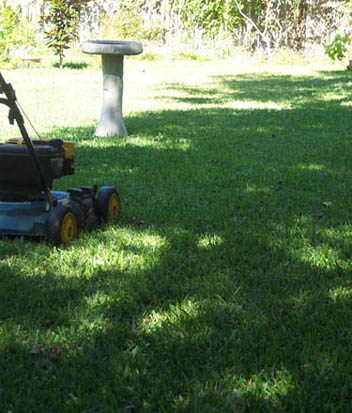
So my thoughts concern mowing, but they're not about the current Lawn versus No Lawn discussions. It’s an interesting topic, but it’s not mine. I’ve been thinking about what happens to your mind when you’re engaged in something like mowing.

When I was a teenager, I occasionally pushed a mower for my parents, but my husband cut the grass once we bought a house, and my sons took over as time went on.


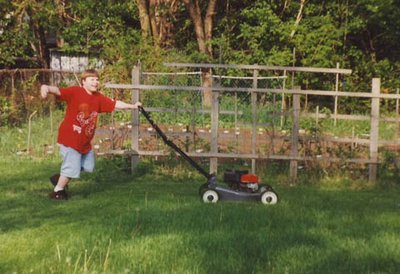
In the late nineteen-eighties, the garden grew more important, and we bought a mower that I could handle. I took over the lawn like a prairie version of May Dreams' blog photo, in denim skirts and a wide-brimmed hat.

One reason to mow: When you're mowing, your family is less likely to interrupt you with the usual demands. The dads mow in suburbia, so when a mom does it, it must be an important job. The sound isn't pleasant, but it becomes a white noise, blocking out the background. I couldn’t hear the airplanes on their way into O’Hare; I couldn’t hear the phone; I couldn’t hear car motors; I couldn’t hear any squabbling. I could think. Some of my best garden plans were developed as I went back and forth and around, mowing my yard, looking at everything from changing angles, noticing and evaluating and concentrating.

Another reason to mow: I knew what was out there and how close to get. I didn’t accidentally mow down struggling young lilies and hostas as weeds, because I was the one who planted them. I also saw things that were not ‘right’ as I passed - catching a shrub before it smothered another, or stopping a perennial before it completed a takeover move.

A possible reason to mow: A non-self-propelled mower means some load-bearing exercise. I use a mulching mower and overlap the lines, and don’t put grass in yard bags.


A sad reason to mow: In the months after my dad died, I could act normal most of the time, but once I started cutting the lawn, the tears wouldn't stop. Was it because mowing was something my father did, for as long as I could remember? Even in his last years, Dad would use his cane to steady himself as he climbed aboard the riding mower.

Or was it the action of mowing, the walking and the formation of patterns in the grass that released bottled-up feelings? In retrospect, now that I see labyrinths designed for walking appear everywhere, at retreat houses, on church grounds and in meditative gardens, this idea seems pretty likely.


Am I alone in feeling like this? Do you mow and think, or mow and plan, or mow and weep, or do you let someone else walk the Labyrinth of your Lawn?

Saturday, September 09, 2006

THOUGHT POPS


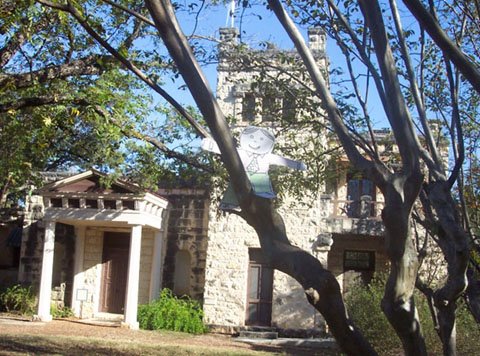
This photo was taken at a place I dearly love, the Elisabet Ney museum in the Hyde Park area of our town.
Tomorrow is Museum Day in Austin – some locations are open free of charge, others have special events for the day and a few have food involved. Here’s a link to the Austin Museum Partnership.


There’s an Iris sale at Zilker Botanical Gardens, [today and tomorrow] sorry - it was Saturday only - so no new iris for me, darn it!.

Scroll to September 9th for details.
I grew at least 50 varieties of Iris in Illinois; some were hybrid cultivars with fancy names and fancy pricetags, while my passalong plants bore personal names like "Ruth's prairie iris", "Dad's blue Siberian" or "Vi's dwarf white".
I liked them all, and planted many tall-bearded, quite a few dwarf-bearded, a handful of Siberian and a few species like reticulata and pseudocorus.
In this 10-year old photo you can see a couple of the bearded iris that grew in our front garden in Illinois. [I have no resistance to the purple shades.]
The varieties of bearded iris is stuck at #4 in our present garden, but the numbers may go higher as more lawn is converted to mixed borders. Along with producing lovely flowers, the plants seem to do well here, so why not?

This is an interesting time to be an Austin gardener who also enjoys reading about Austin gardening. In addition to long-time local garden sites like Soul of the Garden, [from our tireless public-media multi-tasker Tom Spencer], Garden Bits by naturalist/photographer Valerie, and Zanthan Gardens from M Sinclair Stevens, there is a site on herbs and herb gardening called Horsetail Haven from Ann Marie.

While not primarily a garden blog, 'Rantor' also posts entries about what's in bloom in South Austin at Rantomat. The Hill Country landscape is frequently the subject at Lifescapes, by mystery writer Susan Wittig Albert, the creator of the herb-themed 'China Bales' series. Susan Albert lives to the west of Austin, but we'll count her as one of us!

Pam Penick has been writing and posting incredible photos at Digging for quite awhile, with newer blogs R Sorrell’s Great Experiment and my Transplantable Rose beginning within weeks of each other in June.

On August 28th, we heard a welcome new voice when Austin Susan started telling us garden stories at South of the River. A few other sites that sometimes talked about gardening, like Martha's, are not active now, but may return some day. Are there any more local garden writers that I've missed?

I'm happy to be one of the Austin Garden Bloggers in such an interesting town.


Sunday AM: I think the Susan Albert link will work now.