

 Posts
Posts


 Do you remember July? Many of the plants seen on July's Garden Bloggers' Bloom Day haven't forgotten it: A new stalk of Amarcrinum 'Fred Howard' suddenly shot up next to a pink cuphea full of bees. The pink gaura never stops, the balloon flowers keep opening as long as I pop off the old buds, and there are a few mini-roses, too.
The container plants like impatiens and this lantana-and evolvolus combo may not stop until Halloween. The blossoms continue on Oxalis, butterfly bush, orange cuphea and Batfaced cuphea, dianthus, Turkscap, Rock Rose/Pavonia, Salvia greggii and Zinnia linearis. One or two buds appear biweekly on the 'Little Gem' magnolias. The Russian sage plants all look ratty and the phlox does, too, but I'll count their few florets as blooms. When mealy bugs attacked the 'Black & Blue' salvia and the Salvia guaranitica I cut them down to ground level.

Do you remember August? September doesn't look much different here, still decorated with one open stalk of Hedychium coronarium/White Ginger, the delicate Cypress Vine, Coral Honeysuckle, Plumeria/Frangipani, Bengal Tiger canna, night-blooming jasmine and blue plumbago.

Looking out the back door I see the obelisk concealed beneath moon vines and blue pea vines. At right, nearer the fence, the Blue River II white hibiscus is balanced by the white 'Acoma' crepe myrtles at left. My neighbors on the left and at the back grow tall pink crepe myrtles which loom overhead. Something tall & yellow is missing - the native Sunflower is just a browned stalk now.

Once again the passionflowers have buds, with no new caterpillars in evidence. I hope they get the chance to open.

All the yellow trumpets turned white and fell from the Brugmansia/Angels Trumpet, leaving buds as promissory notes for next week. I feel a little guilty about this, since gardeners like Kate in Saskatchewan have already had to cover plants at night.
 The most exciting September openers were a gift from MSS at Zanthan Gardens, the Oxblood lilies/Rhodophiala bifidia seen in the last post. I planted the bulbs in small clumps in six parts of the yard, and they've opened one after another [ perhaps in response to sun exposure?] then faded. This bouquet opened just in time.
Two large plants of Pineapple sage/Salvia elegans are barely budded, opening only one flower. I love the smell of the crushed leaves and have read they can be used in fruit salad, teas, and jelled desserts. Last winter knocked my plants back to the ground but in gentler years flowers also form in spring so they're here to greet the hummingbirds upon their return. I'm not sure if the salvia will open fully before our hummingbirds leave this fall.

The annual portulaca sulked during the rainy part of summer. It's a chunkier cousin to moss rose which never grew much, but I like that coral color.

This summer's odd weather also delayed the blooming of the tropical milkweed/Asclepias curassavica - I haven't seen any Monarch caterpillars as yet. Several generations of larvae grew on last year's plants and these flowers are ready if the Monarchs return.

Two of the three plants of Blue Skyflower/Duranta erecta finally deigned to bloom. The flowers on both are in the blue-purple range, but this one has white edges that reflect light in an interesting way - all I did to the photo was to resize it.
 Oh - here's another new blossom. My friend Ellen, giver of the gorgeous grape-scented iris, also gave me a start of an unusual kind of Butterfly bush. We're pretty sure it's Buddleia lindleyana. Unlike butterfly bushes such as 'Black Prince'. this one is not upright but weeps, dangling long droopy flowers that don't start until late summer.
  Okay, May Dreams Carol! Here's the final flower for September Bloom Day - I can't leave without posting this night photo with flash, celebrating the fragrant flowers on the Moon vine.



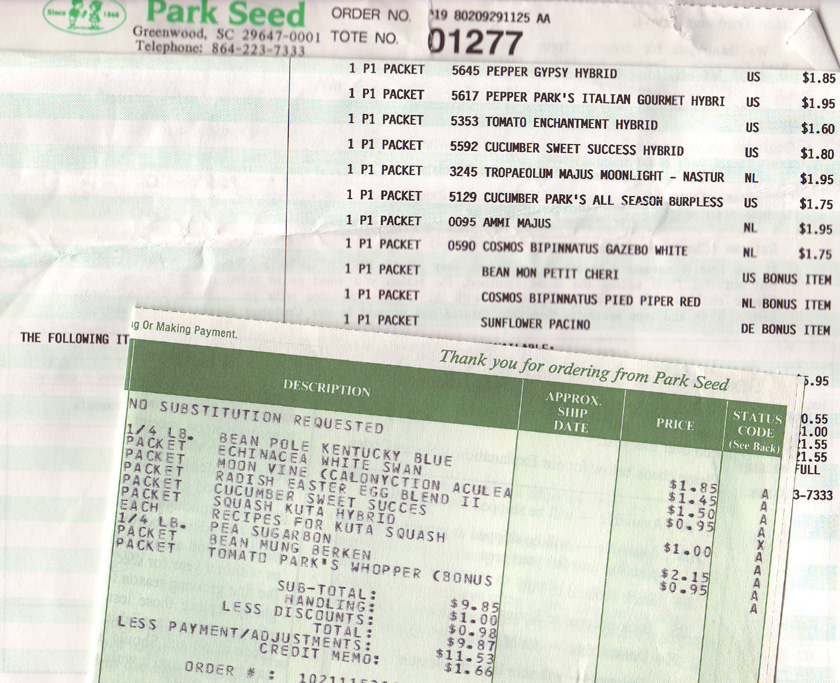
 With this system, Philo grew interesting, hard-to-find varieties of tomatoes and peppers, and I was able to start perennials from seed, like Blackberry lilies, columbine, white coneflowers, Lychnis coronaria alba and splashy hardy Hibiscus.
