About Me
My Photo
Annie in Austin
Welcome! As "Annie in Austin" I blog about gardening in Austin, TX with occasional looks back at our former gardens in Illinois. My husband Philo & I also make videos - some use garden images as background for my original songs, some capture Austin events & sometimes we share videos of birds in our garden. Come talk about gardens, movies, music, genealogy and Austin at the Transplantable Rose and listen to my original songs on YouTube. For an overview read Three Gardens, Twenty Years. Unless noted, these words and photos are my copyrighted work.
View my complete profile
Showing posts with label Garden Book Club. Show all posts

Sunday, June 01, 2008

Beautiful At All Seasons by Elizabeth Lawrence for GBBC

This post on the book Beautiful At All Seasons was written by Annie in Austin for The Transplantable Rose.

Elizabeth Lawrence wasn't a TV star in charge of garden makeovers- she lived with her mother, made gardens in a couple of Carolina cities, wrote columns for local newspapers, corresponded with other gardeners and was the author of several beloved books, including A Southern Garden,The Little Bulbs, and Gardens in Winter. Bill Neal gathered up many of her columns in Through The Garden Gate, published in 1990. Now, more than twenty years after Miss Lawrence's death, we gladly pony up the price of another collection of her columns, written for a local audience back when the president was named Eisenhower, Kennedy or Johnson. The plants Elizabeth Lawrence speaks of may be regional, but her thoughts are abounding and universal and what a trip you can go on when following her words! Do not think she writes only for the South or that she has nothing to say to modern people. This classically educated woman may look ladylike but she is interested in everything and to get to the plants she'll join her friends in crawling across the forest floor hoping to catch a scent from early wildflowers, or confess to sneaking into the University of Padua Botanical Garden when it was inconveniently closed, only to be chased out of the park by furious Italian guards.


Beautiful in all Seasons, Southern Gardening and Beyond with Elizabeth Lawrence was put together by North Carolina writer Ann L. Armstrong and Lindie Wilson, the woman who bought Elizabeth Lawrence's house in 1986, thinking she'd bought a house but discovering that she now owns a garden shrine. The earlier collection, The Garden Gate, consists of columns written between 1957 and 1971, arranged rather like a daybook, taking you throughout the year. Beautiful In All Seasons is divided by subject matter, allowing you to read what EL wrote about the same plant, idea, principle, or holiday over the years. Since both books consist of short newspaper columns, they're perfect for quick refreshing dips when time is tight.


The introduction to Beautiful At All Seasons speaks of Miss Lawrence's "well-furnished mind" - a concise and exact description of what it's like to read her books. Do any of you know the Spencer Tracy & Katharine Hepburn movie Desk Set, seen here in a poster from Amazon.com? The 1957 movie pits research and information person Katharine Hepburn's memory and retrieval skills against Spencer Tracy's EMERAC, the room-sized Electronic Brain. Somehow I think Elizabeth Lawrence would not only triumph over EMERAC, but would be a whiz on getting the best out of Google if she were around today.


I'm so glad MayDreams Carol chose this book for the Garden Bloggers Book Club! Although I didn't receive my copy until Friday, I've already taken quite a few refreshing dips, and was pretty pumped up when I read the article titled 'Importance of Garden Details'. Both Elizabeth Lawrence and I came up with the same Aspidistra/Holly Fern combination after trial and error. But she discovered this in 1963, while my reinvention took place in 2005.

Last week something EL wrote in 1970 added an extra dimension to my day. The cilantro was going to seed all over so I'd been harvesting some of the little round seed capsules, leaving some to reseed. You probably know that while the leaves are cilantro, the plant is Coriander.

I was collecting these coriander seeds for Chicken Mole, bu
t while gleaning the seeds off the stems, I remembered that in a column called "Savory Seeds" from Through the Garden Gate, EL had talked about coriander seeds, along with others in the umbelliferae like caraway, dill and fennel. She said that coriander seeds were once coated with fondant to make a type of comfit, used to bribe children to be quiet in church. She noted that, "Alice had a box of comfits in her pocket when she followed the white rabbit down his hole. She produced it at the end of the Caucus-race....there was exactly one apiece all round."

I looked at the seeds - trying to imagine something that tasted like cilantro as the center of a candy, rinsed off a couple and gingerly bit them. The taste was quite different from the leaves - it was like some kind of citrus. With the outside temperatures approaching 100 °F and the A/C chugging away, it didn't seem like a good idea to pull out pans and a candy thermometer and make fondant...perhaps there was a simpler way to make a coriander candy. A few Ghirardelli 60% chocolate chips smooshed around a couple of coriander seeds tastes enough like chocolate-covered orange peels to keep even me quiet for a few minutes.

This post on the book Beautiful At All Seasons was written by Annie in Austin for The Transplantable Rose.

Monday, March 24, 2008

Second Nature by Michael Pollen, GBBClub

This post, " Second Nature by Michael Pollan, GBBClub ", was written for my blogspot blog called The Transplantable Rose by Annie in Austin.

The writer studies literature, not the world. He is careful of what he reads, for that is what he will write. Annie Dillard


Annie Dillard’s quote appeared in the bridge column of today’s newspaper – guess she’s relevant everywhere! Those words remind me of my own history with Second Nature. I first read the book when it was new, partly because of an April 4, 1991 review in the New York Times. The yellowed newspaper article paper was still clipped between the end sheets of our copy.
I remember enjoying the book tremendously but didn’t feel the earth move – by that time Philo and I had owned 3 different houses with landscapes and gardens to tend. We’d already had our own battles with groundhogs, squirrels, raccoons, invasive plants and the tyranny of lawn as we tried to figure out what to keep and what to get rid of in each successive, pre-owned suburban yard.

I can’t imagine what it would be like to find this book as a beginning gardener looking for a guidebook. Reading Michael Pollen felt less like life lessons and more like the tales of a companion in the garden – a very well-educated, extremely articulate, confident, slightly bratty companion who was a few years younger, and who grew up on the East Coast, with different weather and plants, a lot more land, from a family with a great deal more money. It was fun to hang around with him, even when he did things that made me shake my head in disbelief – planting a Norway Maple? On purpose?

But I liked many of his ideas and his book influenced me to try a few things. At that third Illinois yard I mowed a path from the gated square garden behind the house out to the vegetable garden, past the fruit trees, leaving the grass to grow on the sides of the path all summer as a symbolic meadow. Few meadow flowers appeared but I noticed that the groundhog was so happy with the green and juicy clover growing along the path that he seldom bothered to go all the way back to the vegetable patch.

I loved the way Mr Pollan pondered the many possible consequences of actions in the garden – trying to guess what could happen. We bonded over the idea that Nature has no set plan for an area, that randomness was more true than Disney tales, that there is no way to be a gardener without making decisions, taking sides, choosing favorites and sometimes destroying trees and plants in order to make things better.

In the real world, all the trees may want to be the only tree and some plants will kill to be the main plant, but we don’t see the strife and battle because it all happens in slow motion. That Coral honeysuckle and Lady Banks rose make a lovely blend of color and leaf on the arch but they are engaged in deadly combat and only I with my garden shears enforce the peace.

After 17 years in publication, Second Nature is still lively, funny, thoughtful and worth reading – not as a road map for gardening but as a very personal account of one young man’s journey in the garden. As Annie Dillard warned, reading this book has influenced my own writing, and maybe some of my thinking.

One chapter in the book tells of a wild forested area destroyed by a monster storm and what could happen if it were left untouched, or was partly repaired, or bulldozed or treated like a garden. That led me to consider my own yard. Left to itself what would my own garden become? I’ve heard that the land around here was graded and filled many decades ago and that not much remains of the original landscape. Whenever I weed the borders it appears that my garden wants to be a pecan grove choked with understory invasives like Nandina, Waxleaf Ligustrum and Asiatic jasmine. If any open spots are left after those plants take over there may still be room for the native Ten-petalled anemone, Cooper’s Lily and Copper Lily, all of which popped up here on their own.

But most of what seeds or spreads here didn’t start out in Texas but in Asia.
Most of the native flowers in my borders are here because I, the gardener, planted them and because as a gardener I prune back trees to give the native plants sun and keep aggressive plants from overwhelming them.

This new front bed has tough garden plants like the ‘Mutabilis’ rose, cannas, Verbena bonariensis and larkspur , It also has Texas plants like salvias, bluebonnets, lantana, Gaura lindheimerii, Gregg’s mistflower and Anisacanthus wrightii. My managed landscape may not be “Nature”, but there will be something here for birds, butterflies, insects, lizards and humans.

Although the land in my neighborhood was probably changed a lot, I think Central Texas author Susan Albert’s land was altered less and it didn’t lose its wild plants and wildflowers. Susan’s Nightshade Blog Tour will stop here in a couple of weeks to talk about “Unbecoming A Gardener”, about her relationship with wild plants. The first stop in this Blog tour was today’s post at Carol/May Dreams Garden.

Carol is also the founder of the Garden Bloggers Book Club. For the February/March meeting Carol wrote about the Rabbit War Rules – these musings on Michael Pollan’s book will be my contribution to the book club.


This post, " Second Nature by Michael Pollen, GBBClub ", was written for my blogspot blog called The Transplantable Rose by Annie in Austin.

Friday, February 01, 2008

Unmet Deadlines

This post, "Unmet Deadlines", was written for my blogspot blog called The Transplantable Rose by Annie in Austin.
It's been fun to take part in the monthly community postings offered for garden bloggers, like bloom day, the book club and Garden muse. I made a post for January Garden Bloggers' Bloom Day - but the other group activities? They're just not happening right now.

It's already February 1st and there's no book club post for Carol, partly because Dear Friend and Gardener didn't arrive until last Saturday. I've read some of it, making notations on post-its but I'm finding it very slow going. Until I finish it, I'm not peeking at any of your reviews of this book.


When the Chatto/Lloyd book arrived, I was already engrossed in this Christmas gift from some Left-Coast members of our family. Michael Palin's Diaries from the Monty Python years has been completely fascinating - he was my favorite Python, and the diary is not only about the show and the movies, but his at-the-time thoughts about whatever was happening in the world. He's only a few years older than I am, so reading what he saw and thought starts reverberations in the memories of what I saw and thought in the years 1969 to 1979.

It's February 1st and there's no garden muse post. I like Carolyn's idea and have joined in before, but had nothing to say this time. Soon I'll visit those who've posted for this month.


It's February 1st, so where is the 2007 Diva Diary? I started the Divas of the Dirt website in July 2003 in tribute to this group of gardening friends and each January I write a rambling, chatty story of what we did during the previous year. It's fun for me to revisit our landscaping projects, compile the narrative and format the many photos. The post can be finished once a couple of the Divas email their recipes. We had a wonderful time at our January planning breakfast and the first project for 2008 is scheduled for later this month. Any days spent with Diva friends are precious.

I've read some of your latest posts, but haven't commented much - it's fascinating to see what's happened to our niche in the blogosphere this winter! Snowbound gardenbloggers are pouring forth narratives - past glories, present activities and future dreams are spread out like a banquet, fun to read for those who can't be outside.

This is wonderful! And while you're all busy reading and writing, I can be outside...it's really windy but not terribly cold. I'm not doing anything worth blogging about - photos of someone shoving pots around the patio would be as exciting as a video of reorganizing the towel closet. I sure don't want to write about picking weeds out of gravel! I seem to spend a lot of time just standing in the yard under the shadows of the leafless pecan branches, looking and thinking or maybe not thinking.

After removing all the frosted and faded flowers from the camellia, I couldn't resist playing with the blossoms.


The freezes get a few flowers each time but not all of them are browned, and there are many buds still coming. Last year the last flowers opened in late March.


The small, brown and fuzzy buds are starting to swell on the Michelia figo, promises of small flowers and an elusive banana fragrance from this small member of the Magnolia family.


Today I went to three nurseries - looking for another Rosa 'mutablilis'. We bought a large mutabilis for the front of the house last fall and I want a smaller plant near the patio. When I walked out to the car I noticed that this white passalong iris had opened in the pink garden near the driveway.

There are songs in my head - one that could be fun when out-of town guests arrive in a couple of weeks and one song written in 2004 that might be shaped to fit on YouTube. Thalia has already added a comic twist to the lyrics but Euterpe is needed to get the music arranged. My muses don't stick to any schedule - they appear and speak when they choose to do so. Maybe a YouTube will happen - maybe not.

In the meantime, I like looking at this lovely Cyclamen from my friend Dawn, who blogs at Suburban Wildlife Garden. I'm still planning on what to put in the cool round concrete planter I bought when Dawn and I visited Potager's right before the shop closed... a souvenir of a lovely day with a friend.
This post, "Unmet Deadlines", was written for my blogspot blog called The Transplantable Rose by Annie in Austin.

Monday, November 12, 2007

Garden Bloggers Book Club - Green Thoughts by Eleanor Perenyi

Added December 2 - here's a link to the roundup of all the posts on Green Thoughts with some interesting questions for discussion from Carol of May Dreams-

This post was written for my blogspot blog, The Transplantable Rose, by Annie in Austin.
Green Thoughts: A Writer in the Garden by Eleanor Perényi is the current selection for the Garden Bloggers Book Club started by Carol of May Dreams Gardens.


For a dozen years, I took Green Thoughts out of the town library on an annual basis, then didn't see it for a decade until I recently bought my own copy. How could I have gone so long without an occasional bracing dose of this sophisticated, precise writing? Although Eleanor Perényi wrote this book in 1981, not only does it seem timeless, most of it seems current! She uses the alphabet to organize her essays, speaking of design, color theory, the weather and the delights and disappointments of growing new plants. But it's not a how-to book - her interests range from garden history [with an accent on the female side], to botanical language, cooking and sociology. These essays are delightfully informative and rivetingly opinionated- no wonder they turn up so frequently in anthologies and collections.


If you've already read Green Thoughts you probably have your own favorite topics - if you haven't read this book yet you're missing out on a wonderful set of essays - dip into "Blues", "Herbs", "Tools" or "Woman's Place" for entertainment, enlightenment and enjoyment.


When Mrs Perényi wrote this book, more than 25 years ago, she'd already encountered most of the ecological problems we still face, with Global Warming the exception. Her discourses on fresh vegetables fit the way we cook and eat now, her approach to things like watering, mulching, pesticides and compost make her words timeless. If you find yourself balancing on the border between respecting nature and loving to garden, read her essay on "Naturalizing" and know you've found a companion for the journey.

Reading Green Thoughts again after such a long interval made me wonder how much I'd been influenced by those earlier reads - in addition to what she taught about growing plants, when it came to garden philosophy there were so many points on which we agreed! But which came first? Did Eleanor's words form my ideas or did I enjoy those words right from the beginning because they reinforced what I was already feeling?

It's not necessary to know a lot about Eleanor Perényi's life to enjoy this book but I was always curious about her. That worldly air… that confidence… that exotic name… those hints at life in other countries…a mention of a poet and how her garden ended up in his poem. The biography at the back of my copy of the book tells us of her marriage to a Hungarian baron, a son, and a garden in Connecticut. She was born Eleanor S. Stone in Washington, DC. Eleanor's father was an attache with the Department of the Navy; her mother was an author and a descendent of the founder of the New Harmony Colony in Indiana. This Navy family was posted abroad so young Eleanor lived in several countries with exposure to other cultures.

I found references to Eleanor’s mother Grace Z. Stone, the very popular novelist who sometimes wrote as Ethel Vance. Several of her books were made into movies with major stars playing the characters... how I'd love to see The Bitter Tea of General Yen, which starred Barbara Stanwyck and was directed by Frank Capra!

On another site I read that Eleanor Perényi was only 19 when she met and married her Baron and lived on his family’s estate in the late 1930's. This land was once Hungarian but borders changed so it was part of Czechoslovakia as the second World War began. Eleanor told their story in the book More Was Lost – another title for my wishlist! She was nominated for a National Book Award for writing Liszt: The Artist as Romantic Hero, a biography about composer Franz Liszt. She edited and was a contributing writer for magazines like Madamoiselle, Harper's Bazaar, Atlantic Monthly and Esquire.

The garden in Green Thoughts existed in coastal Connecticut - a historic town first settled in the 1600's, somewhat rural, but with both Boston and New York City not too far away. Amherst professors and famous writers spent their summers there and it would seem a perfect setting for the author's personality as it is revealed in this garden book. One of the chapters of Green Thoughts mentions Gertrude Jekyll, the garden designer who at age 89 sat in a chair while firmly directing workers in the garden. I think Eleanor Perényi is near to that age herself now. I hope she still has a garden in Connecticut - and I hope she knows how much her readers appreciate her.


Before you go online to get the book, please check out the current post on my other blog, Annie's Addendum, and help me identify a few plants. Over there you can also see a larger photo of the intriguing treehouse drawing seen at the top of this post. The covers were changed for later editions, but since Eleanor refers to the drawing in one chapter, you might like to see it.

Friday, September 28, 2007

Garden Bloggers' Book Club - Thyme of Death

I enjoy mysteries, and some of my favorites are the kind that come as part of a series, with an amateur detective as the main character. For the Garden Bloggers Book Club, Carol has invited us to read a mystery connected to the garden - a sub-species of the mystery that may have its origins with Agatha Christie's Miss Jane Marple and Jane's garden-mad friend Dolly Bantry.


I considered reading the official choice, but decided instead to make the club a reason to buy another volume of the China Bayles series, by Susan Wittig Albert. China's adventures as a lawyer-turned-shop owner are fun to read no matter where you live, but since both she and her creator dwell in Central Texas, for me the local angle is irresistible!

The book I bought is called Thyme of Death - the first China Bayles book, which began the series in 1992. Shortly after we moved here I was introduced to China with a book belonging to the middle of the series so I thought it would be interesting to see how we first meet China Bayles. Susan Albert introduces China as a fully-formed character, with her personality and beliefs evident right from the beginning. I do think that a couple of the other characters seem slightly stereotypical in this first book. China and her friend Ruby lose a terminally ill friend to what looks like suicide, but may actually be murder. We find out a lot about everyone in town as the story unfolds. Thyme of Death was nominated for both Agatha and Edgar awards - the plotting is pretty good, the conversations engrossing, and the details of life in the town of Pecan Springs make the start to the series special.

In real life, Albert's fans have been heartbroken to discover that they can't actually go to China's Thyme and Seasons Herb Shop with it's adjacent garden full of fragrant herbs. Alas! Pecan Springs is not a real town, although after reading one book, you may sympathize with those confused fans and wish that you could visit China's shop, too. There is a genuine sense of place in these mysteries - the town may be fictional, but the geography, biology, botany, genealogy, and meteorology are real. The medical and forensic details of the murders seem well researched, and with a Texas lawyer as the main character, there are opportunities to explore how local laws work, along with some comments on political events. Each book has a relevant plant or herb in the title, and many of the later ones have a recipe or two, including these two favorites.


Susan Wittig Albert is also the author of another mystery series called the
Cottage Tales, with Beatrix Potter as the mystery solving protaganist. We recently rented the recent movie Miss Potter, and enjoyed it very much. I don't require a film biography to be all that accurate - it's a movie! But once the credits have rolled, I want some facts about the real person. I read Susan's review of the movie and found out that most parts of this Beatrix Potter bio-flick were factual, but some scenes were pure fiction, and that timeframes were shifted for dramatic reasons. Now I'd like to read some of the Cottage Tale series, to see how Susan imagines Beatrix - and to guess what kind of actress should be calling her agent and optioning the book!


Susan Albert not only tells a good yarn and spins a fine mystery - she also spins, dyes, weaves and knits real yarn. And she's even a blogger, writing about her Hill Country home and garden, wildlife, and fabric arts at Lifescapes and appears on local PBS, visiting with Tom Spencer at the Central Texas Gardener.

Knowing something about the author is fun, but you can enjoy China Bayles without any backstory - just open the book and head down the path to Pecan Springs.

Added Oct 1st: Carol has links to the other reviews at her Virtual Book Club meeting.

Tuesday, July 31, 2007

The Multi-tasking Garden Blogger


Here's the dilemma:

I met with the Divas of the Dirt on Saturday and wanted to write about it.

I’ve been immersed in a genealogy project and wrote a report.

We had 4 inches of rain last week and I have a push mower.

Philo and I are looking at paint chips. Why do the colors I like always have food names? Like butter, cream or Belgian Waffle?

Hank wrote a wonderful 15,000-word essay centered around Hydrangeas and I read a lot of it. Here's a link to the 15,000 word essay but be aware that downloading his blog entry will take some time.

My book report for the Garden Blogger’s book club is due today.

Sweet Home Chicago Carolyn’s Poetry day is planned for tomorrow.

I decided to knock two things off my list with a rhyme about the book. Here goes:


My Summer in A Garden by Charles Dudley Warner
Is a public, domain-free download from Google.
But a paper book is nicer for relaxing in a corner -
Wish I’d made that choice instead of being frugal.

I viewed the screen and scrolled along as Charlie spun his stories,
Connecticut’s the setting; Eighteen-seventy the time.
For nineteen weeks he hopes for horticultural-type glories,
But deals instead with critters, weeds and clime.

His manner is quite jocular, avuncular and dense.
While making fun of nation, gender, sect.
When sticking to his garden Warner’s words are full of sense
But some parts are not Politic’lly correct.

If you like hoes and vegetables these tales will make you smile
I chuckled at his Devil Grass and produce-swiping folks.
Though Warner’s gone from this world for a very long, long while,
Just search the web – his name lives on in snappy quotes and jokes.


The Divas of the Dirt had a great morning at the Austin Smith & Hawken, enjoying a talk by manager Zach on outdoor entertaining. We later went to brunch and there was shopping involved. That blue cactus mosaic at the top of the page was seen at the new Domain shopping center. Go read about our day, see more new photos and find links at the
Divas of the Dirt blog.
[A bit of clarification, added August 1st:
I'm happy to be a member of two separate groups of Austin gardeners - the Divas of the Dirt, who do garden projects together, and the Austin Garden Bloggers, who write about gardening. I write about them both, but the groups are not connected in any other way.]

Sunday, May 27, 2007

Passalong Plants - The Book

Passalong Plants -the April/May Selection for the Garden Bloggers’ Book Club.
By the time this book came into my life, my world was already filled with plants passed along by other gardeners, so Felder and Steve [we were instantly on a first name basis] didn’t introduce me to the concept, but they gave all of us a great name for what we were doing, validated our experiences and filled an entire book with objects of desire. We were introduced to some quirky yard art as well as some truly odd plants.

The two authors, Steven Bender and Felder Rushing talk about individual plants in a neighborly, anecdotal way, sometimes lurching over the line into Jeff Foxworthy territory, but with genuine horticultural information under the kudzu. I have no resistance to this kind of Southern- style writing, treasuring old paperbacks by Lewis Grizzard and Celestine Sibley, enjoying the YaYa Sisterhood, and loving movies like Steel Magnolias and Fried Green Tomatoes. If you can’t swallow garden writing served with a side of cheese grits, you may need a lot of iced tea to get you through the pages, but the plant stories are wonderful. I love my copy, sometimes rereading the book for fun, and sometimes using it as a reference for specific plants.

Many of the most tempting stories are about plants that won’t grow above zone 7, giving the Northern gardener a case of zone envy. Felder and Steve are currently considering a new book about Passalong Plants for colder zones, so if you live where camelias freeze, read this book first and hope they’ll write a companion volume in the future.
Last March, I posted about meeting Felder Rushing, and mentioned that my copy of the book was written-in, and stuffed with notes. The extra pages at the back of the book were blank when I bought the book, but were soon covered in lists of plants and people. I noted daylilies named ‘Timeless’ and ‘Charm Bracelet’ as coming from Bernice, that Sweet Autumn Clematis was given to me by Ruth, whose plant came from Sophie. The Malva moschata was from Dorothy, Iris from Lorraine, Peonies from Patty, Sweet woodruff from Sherry, orange lilies from Laverne and that the Jack in the Pulpit was passed along to me by my mother. Most of the passalong plants in our Illinois garden stayed there when we moved to Texas in 1999.

But among the passalong plants in my present garden are two that traveled long and winding roads to live in Austin, Texas.

Look into the photo above and you’ll see some tall while phlox, cavorting with a white Echinacea and some Perovskia last July. The family legend says that my great-grandmother grew the phlox in Michigan in the early 1900’s. By 1924 she'd given a division to her daughter, my Grandma Anna, who took them to Chicago. Grandma passed them along to my parents in the 1950’s. Decades later, I took some of the white phlox with me to a rental townhouse, then to our first house. Another four years passed, I redivided the burgeoning clump and took some to our second house, then repeated the process and planted them in the square garden at the third house, seen below.

The phlox are blooming in the upper left corner of this decade old snapshot - with the head of an 'Annabelle' hydrangea flopped artistically across the center.
In the mid-nineties our son M. took some of the white phlox for his garden and after we moved to this house in 2004, M. returned the favor, bringing a division of the heirloom phlox down here - to make this the fifth home where we’ve grown them.

The journey of another plant began on April 13, 1992, when a garden club speaker in Illinois gave me wands of corkscrew willow - extra greenery from an arrangement. I managed to root one of the slender twisted branches and grew it in a whiskey barrel. The wand eventually expanded into an attractive tree, from which I rooted more cuttings, one for my son M. and a couple for my friend Barbara.
We left the original tree in the whiskey barrel in Illinois, but after a while I missed it, and wanted one here. Both M. & Barbara gave me wands from their now larger trees, with no luck at first, but this piece from Barbara finally made roots in 2005. The young willow now grows in a big pot, placed so any drip of condensation from the roof will land in the container. Also in the container are some passalong agapanthus plants from Pam/Digging.
I started writing this while waiting for a couple of passalong daylilies to bloom, but as I waited, the draft grew longer and longer, and now the daylilies need a whole post! Since I want to tell the stories of the passalong plants in our garden and the people who shared them with us – let’s call this Passalongs/Part One.

Monday, March 26, 2007

The Gardener's Year


Last year I noted that that a book called The Gardener’s Year by Karel Čapek was one of the recommended books at the Zanthan Gardens site of M. Sinclair Stevens. When I saw a copy on sale last fall, I was delighted, and then was delighted a second time when it became the March selection for the Garden Bloggers’ Book Club.

The edition I bought is part of the Modern Library Gardening Series, published in 2002, with an introduction to the series by Michael Pollan, and a forward by New York Times writer Verlyn Klinkenborg. This forward has biographical information about Karel Čapek, and a note that the pronunciation of Čapek is chop-uk, which I’m trying to remember. I found this quote via D.G. Jerz:

Čapek's obituary in Newsweek (January 2, 1939) said of the play R.U.R.: "Although he believed it the least interesting of all his works, it brought him greatest fame."

In 2007, the play R.U.R. is till famous and read by students of drama, but doesn’t it seem as if this little volume of garden philosophy has a wider readership? Perhaps Karel Čapek would be amused at that.

The Gardener’s Year was written in the Czech language and was first published in 1929, then in 1931 was printed in an English translation. 1929! That’s 78 years ago, but its descriptions of ridiculous, obsessed, yet still hopeful plant people sound like gardeners in the present, even though there have been changes in gardening over the decades. We still take the weather personally, forget what we’ve planted, buy too many plants, use the feasts of saints as days for planting crops, and struggle with garden technology – and we garden bloggers are all bonding with the author over our still unmanageable garden hoses.

Josef Čapek, the author’s brother, drew the whimsical illustrations, so full of wishful thinking, with winged gardeners suspended over the flowerbeds. I don’t think we’d love the book quite so much without the drawings! When Josef caught the Czech gardeners in action, the only women seem to be a couple of flappers mowing the lawn in dresses and heels. Was this really true at that time and place, I wonder? Did women not garden? Perhaps using men was a way to avoid indelicacy in the illustrations, so that Josef did not have to draw females astraddle rock gardens with rump in the air.

For me one of the most amazing and endearing aspects of Karel Čapek’s writing was the specific way he spoke about plants and soil. He doesn’t give you three names and then add ‘etc.’ His lists tumble on, his similes stretch for paragraphs and the descriptions are complete rather than suggestive, as when he speaks of of cactus:
There are cacti just like porcupines, cucumbers, marrows, candlesticks, jugs, priests’ caps, snakes’ nests; they are covered with scales, teats, tufts of hair, claws, warts, bayonets, yataghans and stars; they are bulky and lanky, spiked like a regiment of lancers, sharp like a column brandishing swords, swollen, stringy, and wrinkled, pock-marked, bearded, peevish, morose, thorny like abatis, woven like a basket, looking like excrescenses, animals and arms; the most masculine of all plants which were created on the third day, bearing seed according to their kind.
[I had to look up Yataghans and abatis – how about you?]

The military references seem appropriate in hindsight, since Karel Čapek was only in his forties when he died, departing as the Nazis took over his land. For a heartbroken man so in love with soil, with earth, with humus, he may not have minded the leaving. As I read those passages on soil, it occurred to me that a few years after Karel Čapek’s death, another man was born with the same kind of passion for soil. And I kept imagining our John Dromgoole and Karel Čapek in conversation, spreading the word that you shouldn’t feed the plants, you should feed the soil!

Thursday, February 22, 2007

Two Gardeners, A Friendship in Letters

Many thanks to Tracy of Outside for suggesting Two Gardeners, and to Carol of May Dreams Gardens for starting the book club.

In 1988 Katharine S. White and Elizabeth Lawrence were included in Allen Lacy’s anthology, The American Gardener : A Sampler and one taste made me want more from these writers. A couple of their books showed up at our local library and eventually I owned several volumes of my own. My reading of Two Gardeners was less discovery than revelation, as their collected letters to each other unveiled a long relationship. I already felt affection for them - what a pleasure it was to see their connection grow once Elizabeth writes to open the conversation.

This is no vague or gushing fan letter – Elizabeth packs her first missive with information, ready to explode when Katharine opened it. I like to imagine Katharine opening the envelope, then feeling a bit overwhelmed as she learns a great deal about her unknown correspondent: Elizabeth lives in North Carolina; she is not only familiar with the New Yorker, she has connections to one of its writers; she is glad to hear about a previously unknown catalog; she offers addresses and names of other catalogs with detailed descriptions and criticisms of the covers and contents; she also establishes herself as a rose connoisseur, compliments Katharine’s husband while declaring herself a fan of Charlotte’s Web, and gives glimpses into her personal economic situation. What Elizabeth does not mention, is that she is herself a published garden writer of books as well as a newspaper column. Elizabeth didn’t seem to be good at promoting her works, and Katharine is left to discover the wealth of Elizabeth's knowledge from other sources. Katharine soon realized that her new friend was an invaluable horticultural resource.

Although that first letter arrived in May of 1958, Katharine’s literary world has influences in today’s news. The New Yorker magazine is still vibrant, the New Yorker on DVD is a popular item, and a star-studded movie of Charlotte’s Web, written by Katharine’s husband E.B. White, was released at Christmas. Garden Blogger OldRoses just reviewed a flower show with arrangements that cry out for skewering by a new Onward and Upward in the Garden article. It was fun to see names from Katharine’s letters echoing in the present day – Katharine writes of her frequent dealings with William "Bill" Shawn, the famed editor of the New Yorker – and I recently read newspaper articles about his sons, Wallace and Allen. Wallace Shawn, a writer and actor with roles in films from The Princess Bride to Woody Allen's, appeared in theater reviews this winter; Allen Shawn, composer and writer, was the subject of a recent NYTimes article in the Home & Garden section, with reviews of his latest book in another issue. (Just to keep things even more circular and gossipy – Allen is the ex-husband of a previously selected Garden Blogger Book Club author, Jamaica Kincaid. While this celebrity scoop may not rival Britney’s tattoos, it was amusing to me!)

The editor clues us in that Katharine is a decade older, a New Englander, married, divorced & remarried, a mother and grandmother with a long career in the high pressure world of literary editing, her personality infused with the editor’s emphasis on exactness, a recent transplant from the lively city to a farm in Maine.

Elizabeth is a Southerner, never-married, a dutiful daughter and affectionate aunt, living in Charlotte, North Carolina, one of the first women to enter professional landscape design, which she does for a living while writing her column. Elizabeth is a much more active gardener than Katharine can be. Because this book includes some wonderful photos, we can also see differences in their looks and demeanors.

I'll have to read their individual biographies to find out more about their early lives. They’re so familiar with a broad range of literature - did they come from families where reading was respected? Was their gracefulness in manner, correctness in behavior and fluency in expressing themselves instilled from earliest childhood? When these women begin to use each other’s first names, I felt a quite Jane Austen-type thrill at this bold step toward intimacy.

The Presidential campaign of 1960 caused rifts across the country, and there’s a point where our Elizabeth and Katharine reveal their feelings about John Kennedy’s election. They accomplished this quite delicately, letting their positions be known via anecdotes and conversations couched in tactful words that would not mar their friendship. But such courtesy does not mean weakness! Both women had to be strong as they dealt with health, employment and family problems, researched relentlessly to ensure the integrity of their work, and when pain and grief laid them low, they found refuge in their conversations about gardening and garden writing.

Has much changed in the gardeners' world? Terrible and unprecedented weather events threatened their beloved plants, they worried about the ecological effects of chemicals, and bemoaned the closure of favorite nurseries. They wished for the good old days, when people respected fine, opinionated, detailed garden writing.
And even half-a-century ago, publishers chose to give contracts to writers of money-making, didactic, how-to-do-it garden books, while refusing to print reflective, specific garden writing stuffed with botanical names and references. Weren’t similar feelings about boring garden writing one of the factors leading to the establishment of GardenRant?


Through The Garden Gate is a collection of Charlotte Observer articles written by Elizabeth Lawrence over many years. For the book the articles are arranged by the month in which they appeared, and thus Elizabeth takes us through the cycle of the year, investigating customs, seasons and holidays, describing gardens and talking to gardeners. For a dozen years I’d been touched by her poignant July entry for the poet Robert Vernade, but not until reading Two Gardeners did I realize that Elizabeth's research for this article was blocked until Katharine used her influence. These events unfold through the letters between the two women. When I reread that story now, it still touches me, but I also treasure it because I know more about the friendship in letters between Elizabeth Lawrence and Katharine S. White.

The American Gardener : A Sampler by Allen Lacy (Editor) May 1988

Onward and upward in the garden, by Katharine Sergeant Angell White, 1979


A Southern Garden by Elizabeth Lawrence, originally published in 1941, special 50th Anniversary edition, 1991

Through the Garden Gate, Elizabeth Lawrence (Author), Bill Neal (Editor)1990

Thursday, January 25, 2007

THOUGHT POPS, Edition Two

A NEW BLOG DIRECTORY FROM AUSTRALIA Stuart at Gardening Tips’n’Ideas has set up a garden blog directory featuring a blog search engine and a world map dotted with Garden Bloggers. Go to his website , also linked at left, and click the banner to see how it works. You can also add your garden blog to the map. Guess what city has the most blogs so far!

DIVAS OF THE DIRTLate January is the time each year when our annual edition of the Divas of the Dirt Diary is posted, and it went up late last night. If you’re interested in reading about what the Divas have done lately - garden projects, photos, theme song and new recipes - the adventures from 2006 can be found on the Divas of the website, http://www.divasofthedirt.com/


SATURDAY- Lady Bird Johnson Wildflower Center! Diva Candy relayed this notice:
Tree Talk and Winter Walk 2007, January 27, 9 am - 5 pm.
Join the Lady Bird Johnson Wildflower Center in celebrating our annual Tree Talk & Winter Walk on Saturday, January 27, where we will be helping you in “Barking Up the Right Tree”. Our event features a robust Tree Sale, with more than 80 species from which to choose. Purchase the perfect native tree for your urban landscape. Join us for walks and talks, such as how to identify & maintain native trees, & explore the importance of trees in the urban landscape. The day will include a Tree Planting demonstration, and activities for children & families. Don't forget to stop on by our Gift Store, where children's author Michael Todd will be signing copies of his book Texas State Bird Pageant from noon to 3 p.m. You can also get a 20% discount on selected items while shopping at the store (what a deal)!
This one-day free event is packed with organized walks, talks, demonstrations, children’s activities, and useful information on trees including proper tree care, maintenance, planning and landscaping with trees. Join tree experts including: arborist Don Gardner, forester Jim Houser with Texas Forest Service, arborist Guy LeBlanc, and Flo Oxley and Philip Schulze with the Lady Bird Johnson Wildflower Center . Also on hand will be participating organizations providing information about their tree related programs: TreeFolks, FireCap, and the Texas Forest Service. Enjoy the Urban-Wildland Interface exhibit, and discover information you can use for landscape planning and maintenance regarding fire safety.
Sponsored by KGSR. For more information and schedule, visit our website, at: www.wildflower.org.
Stephen Brueggerhoff, Public Programs Manager
Lady Bird Johnson Wildflower Center
4801 La Crosse Avenue
Austin, TX 78739-1702
THINKING ABOUT COMPOST Carol in Indiana [May Dreams Garden] runs the Garden Bloggers book club, with the January title called Teaming with Microbes. I’m looking forward to reading all the posts and plan to read this book eventually. While I can't do a book club post, I do have thoughts about compost.
We were composting long before we read books by Roger Swain, Eric Grissell and Michael Pollan, or had even heard the name Ruth Stout, practically the Patron Saint of Composting. We began subscribing to Organic Gardening Magazine in the middle seventies, receiving this issue in 1978.
I grew up knowing about composting in a general way: Grandma Anna had a cement bin in the alley behind her Chicago garden, complete with access door set into the front, and my dad made compost from the time we moved out to the suburbs. Philo built a compost enclosure at our first house, and when moving from one house to another in 1987, although he was willing to leave the firewood for the new owner, the whole compost pile was shoveled into sacks and hauled to our new garden.

Now our mulching mower helps the grass clippings break down where they fall. We also use this mower to chop most of the fallen leaves, digging them into the vegetable garden so they can compost over winter. We chop some leaves to use as mulch on some woodland-style beds and borders. I crack & snip smaller sticks to mix in with the mulch, and occasionally put citrus peels through the blender with water, pouring the slurry in garden beds. But we no longer have a designated compost pile or bin.

Our Northern yards were narrow and long with space for a compost pile a reasonable distance from the house. But this neighborhood has irregularly-shaped lots that are wide but very shallow, with short, winding streets. Our lot and the other 4 lots with which we share property lines don’t have right angles – they’re more like pieces of a jigsaw puzzle. Since we have no ‘out-of-the-way corners’, from any given location in my yard it’s a very short distance to a dwelling, whether my neighbors’ or my own. Instead of being manufacturers of compost, we have decided to be consumers of compost.


And you know what? It feels pretty valid to me. We can buy all sorts of compost from local organic dealers, sometimes going to the you-dig places like Garden-Ville and the Natural Gardener. We buy a great deal of Texas Native Hardwood Mulch, made by a firm here in Central Texas; using it helps keep tree trimmings out of the landfills. We buy organic liquid composts and soil activators like Medina Soil Activator and Terra-Tonic, Medina Hasta-Grow and LadyBug products.
Although we enjoyed our years of making our own compost, buying organic compost products is a good thing, too, encouraging these companies to continue composting on a large scale.

Sunday, November 19, 2006

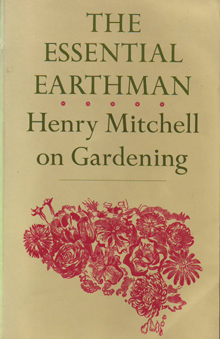
The Essential Earthman


When Carol chose The Essential Earthman for her Garden Bloggers Book Club, I was pretty sure the garden bloggers would enjoy it, but wondered what an average new gardener would think about it. Henry Mitchell started writing his garden columns in the mid-1970’s, around the time that Philo and I bought our first house. Back then, the gardeners we knew might have a basic reference book or two, but were likely to ask friends for advice or use the library to look up plants and their care. Learning how to grow things came with homeownership, stick trees abounded, and the front yards in some neighborhoods became startlingly similar, as neighbors grew and passed around divisions of the same variegated hostas, orange daylilies, phlox and iris.
If you could remember a few botanical names, liked to mail-order unusual plants and were building a collection of garden books, you became known as a ‘plant nut’, and I earned the label while gardening at our second house in the eighties. At some point, I left the ‘how-to’ books on the library shelves, taking home writers like Allen Lacy and Henry Mitchell, whose detailed observation, passion for plants and personal garden philosophy outweighed many tomes of instruction.


Twenty years later, anyone can Google, so no one needs to search through 14 or 15 books to identify a single perennial. News stories tell us that few people will wait for shrubs or trees to grow – they flip the house after a short stay. I read that half the homes in the US use a lawn service - do the owners ever learn the names of what's in their yard? How can gardeners find a personal style of gardening when they learn about gardens from television? Those instant makeover garden shows instill the personality of the TV host, not the owner.

There also seems to be an undercurrent of antagonism in horticulture news – homeowners associations attack native plant advocates, lawn afficianados & and neat freaks square off with organic gardeners, and those newly converted to ecology seldom tend their own gardens, preferring to criticize everyone else’s instead.
It appears that a garden is now an investment; a garden is now a stage on which to display wealth; a garden is now a political battlefield.

Along comes Carol, sending today's gardeners out to find The Essential Earthman. I cannot imagine Henry Mitchell looking at his lot as real estate – this man inhabits every square inch of his garden! He jams the plants in too closely, grows difficult, exotic plants from all over the world, starts trees from seed, succumbs to zone-envy, takes an entire day to get three tomatoes planted, and is overcome by the beauty of roses and iris. He speaks of the impact of a single marigold in a sea of petunias. He rejoices in small triumphs like one perfect daffodil in bloom, he putters and fusses with his stock tank, gloats over his Chinese bronze dog, and loses track of time. He encourages us not to lose heart as we deal with unpredictable weather, because “It is defiance that makes gardeners”.
I hope he will be an antidote to these depressing news stories, and that H.M.'s words will be like oxygen for those who still want genuine, experimental, personal, overreaching, messy, ridiculous gardens, not reading the pages on fast-forward, but savoring his thoughts, like this one:
... it is the Spectrum not the color, that makes color worth having, and it is the cycle, not the instant, that makes the day worth living...
Henry warns us, “ Your garden will reveal your self. Do not be terrified by that…”
I pondered those words in June as I clicked ‘Post this blog entry’ for the first time, knowing that once seen, my garden was sure to give me away, revealing my self.
I believe in Henry Mitchell’s kind of garden philosophy. His plant-specific advice, however, was written a quarter-century ago, for gardeners living far from Austin, and being under that influence got me in a bit of trouble here.
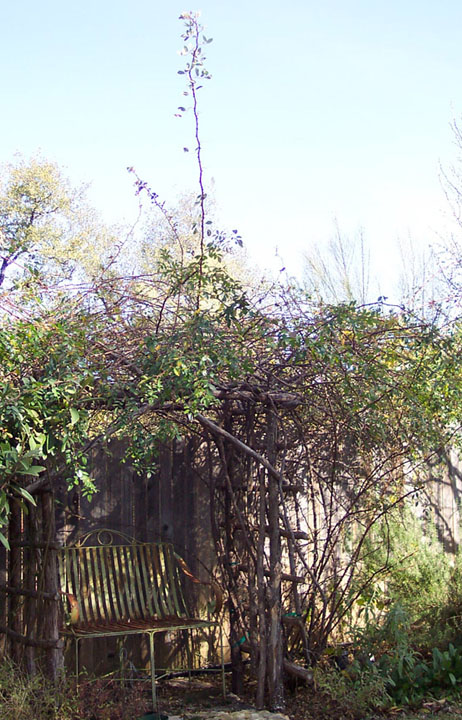
By 2000, I’d read and reread H.M.’s description of the wonderful yellow ‘Mermaid’ rose. Deer ate the roses in my own neighborhood, and I couldn’t grow any, but my friend Diane needed a climbing rose for her large new wooden arbor. I talked her into buying a ‘Mermaid’ just so I could see this rose in full glory. Henry did allow that it could be a 'large' rose, but Diane’s plant went way past “Mermaid’-size, way past ‘Manatee’ size, all the way up to Rosa ‘Orca’.