
About Me
My Photo
Annie in Austin
Welcome! As "Annie in Austin" I blog about gardening in Austin, TX with occasional looks back at our former gardens in Illinois. My husband Philo & I also make videos - some use garden images as background for my original songs, some capture Austin events & sometimes we share videos of birds in our garden. Come talk about gardens, movies, music, genealogy and Austin at the Transplantable Rose and listen to my original songs on YouTube. For an overview read Three Gardens, Twenty Years. Unless noted, these words and photos are my copyrighted work.
View my complete profile
Showing posts with label Seeds. Show all posts

Friday, February 06, 2009

Departures, Arrivals and Amaryllis

This post, Departures, Arrivals and Amaryllis, was written by Annie in Austin for her Transplantable Rose Blog.


POST-FREEZE REPORT FROM NW AUSTIN Mother of Thousands, AnnieinaustinRemember the Mother of Thousands standing tall against the window in January?


Frozen Kalanchoe, AnnieinaustinAlas, it exists no more - frozen to mush by three repeated hard freezes, with temperatures in the mid-twenties.


Frozen bulbine, AnnieinaustinThe necks of dozens of blooming stalks of Yellow Bulbine in the front garden were snapped by the same freeze .

Surviving lavender, Annieinaustin For most of the summer the Fern-leaf lavender threatened to engulf two other varieties, blooming month after month. After the freezes the sweet lavender and Spanish lavender look fine, but the Fern-leafed lavender looks dead. It's been a rather mild winter here so none of these losses are more than what was expected.
Now temperatures are pleasant, but it's really windy and no rain means warnings about fire danger.


Annieinaustin, abstract barline
SEEDS INSIDE AND OUT

In a recent blog post MSS of Zanthan Gardens says the hard freezes in some parts of Austin never arrived in the central part of town. She also notes that she's busy transplanting Larkspur seedlings. Larkspur seedling, Annieinaustin I have no intention of disturbing the single larkspur seedling seen above. It sprouted in the Hummingbird garden - sure hope there will be more! A few radish sprouts popped up in the vegetable plot, but there's no sign of the Cilantro that usually self-seeds all over the place. In a panic at the thought of no Cilantro, I planted fresh seed a few weeks ago but have seen no sign of germination yet.


Seed starting tray, AnnieinaustinIn the early 1990's, Philo built a large, lighted and heated plant table. We had a big garden then and needed to start lots of seeds. That set-up had to be left behind but we kept this earlier, smaller edition with us as we moved from house to house. I recently found it and plugged it in for the first time since we arrived in Texas in 1999, hoping that it can still sprout tomato plants.


Annieinaustin, abstract barlineCAN YOU TELL THEM APART?

Small Narcissus blithely ignore most freezes. I showed you some early Narcissus in the January Bloom Day post, and mistakenly said they were 'Grand Primo'. I don't remember planting them, but a few weeks later the mystery narcissus were joined by the real Narcissus tazetta 'Grand Primo', which I did plant, less than a foot away . The differences are subtle.
January narcissus, AnnieinaustinThe unnamed variety above bloomed in mid-January, with flowers on stalks about 2-feet tall.


Narcissus Grand Primo, AnnieinaustinThe narcissus labeled 'Grand Primo' open in mid-February and they're about 15" tall.


Narcissus & ruler, AnnieinaustinMSS suggested the unnamed narcissus wasn't a paperwhite since those have thinner leaves. Maybe it's 'Avalanche' or 'Nazareth'? To me the individual flowers look slightly smaller than the 'Grand Primo', with more of a point to the petals. The long strappy leaves are wider than paperwhites but narrower than that on 'Grand Primo.


Grand Primo & ruler, AnnieinaustinThe 'Grand Primo' flowers seen seem to be a little larger and the petals seem to flare out a little more before coming to a point. The cups in the earlier photo are closer to the real-life color - the cups in this one aren't quite yellow enough, although they do fade. This identification is tentative but one thing is sure... the scent! Lori is looking for a good smelling small narcissus. The unnamed narcissus isn't too bad, but it's a sure bet I would never let 'Grand Primo' bloom inside. You'll have to keep looking for a sweeter scented variety.


Annieinaustin, abstract barlineMICROCLIMATES

All is not frost and freeze - as
May Dreams Carol has discovered, Microclimates make a difference. Passionvine caterpillar, AnnieinaustinIn a protected corner where fence meets wall in the Secret garden, the 'Amethyst' Passionvine stays green, providing the habitat for what looks like a Gulf Fritillary Caterpillar.


Feb microclimate, AnnieinaustinA few feet away from the Passionvine a bedding geranium stays in bloom. The white impatiens in the same pot has had some freeze damage, but it's alive and rebudding.


Baby Meyer lemon, AnnieinaustinWhere's the safest microclimate at my house? Inside the breakfast room! The Meyer's Lemon lives there for winter, and it's loaded with buds. A couple of open flowers smell sweet and some tiny lemons are developing.


Stargazer Amaryllis, AnnieinaustinThe dark 'Red Dragon' amaryllis at right slowly opened six huge double blooms over a period of nearly three weeks. The first stalk is now reduced to one fading flower and the second stalk has stayed tight at the base. Attention turns to the two flowery stalks of a taller, flashier striped amaryllis named 'Stargazer', with almost all the flowers open at once. The show won't be as long but for the moment, it is spectacular.

This post, Departures, Arrivals and Amaryllis, was written by Annie in Austin for her Transplantable Rose Blog.

Friday, April 25, 2008

Enjoying the Unexpected

This post, "Enjoying the Unexpected", was written for my blogspot blog called The Transplantable Rose by Annie in Austin.

Sometimes the things you plant surprise you in good ways - that's what happened here a few times this week. The temperatures are now in the high 80's, even the late iris are almost done and the phlox foliage is about 8" tall, so the season should be early summer in this part of the long fence bed. Look who just showed up-
This is a 'Pink Pride' daffodil, one of a dozen bulbs planted last fall. The bulbs made foliage but I'd given up hope of seeing a bloom.


My daughter and son-in-law had a mini-rose sent to me last year for Mothers Day - they didn't get a choice of color but knew it would be pretty. The shipment had a rough ride from the organic grower in California but the rose recovered enough to make a couple of buds, in a pale peach color.

Because of last summers flooding rain I kept the mini-rose in a container so it wouldn't drown. It didn't bloom again but branched out and then when cold weather came it lost all its leaves. I kept it in the pot, bringing it in the garage whenever we dipped below freezing.


The rose leafed out e
arly this spring and I planted it near the blue scabiosa and the coppery orange ranunculus. Here's the first rose - not a pale peach, but a color like the inside of a melon, which blends perfectly in this border!

I wonder if the more intense color is a response to more heat and sunlight? I don't see any other buds but the whole plant seems to have more substance and vigor since it left the container. Maybe it will take a little longer for this little rose to settle in and display its true color.


You've already seen the true color of the Schlumbergera/Thanksgiving cactuses - they all bloomed in the breakfast window last winter. Once the chance of frost was low, I moved three of them out to the veranda for the summer. All three plants made another set of buds which are now opening. Very unexpected!


Larkspur is one of my favorite annuals - one reason I love the meadow at Zant
han Gardens. I bought double lilac larkspur seeds in fall 2005 after we had the long fence bed started, and threw them around. For three springs they've sprouted and grown, and usually bloomed, but the flowers in Central Austin usually bloom a few weeks earlier than mine here in NW Austin. Larkspur like air and sun so last year's wet spring made their flowering season very short. The double lilac larkspur are blooming now and have reached new heights - I'm 5'6" on a good day and my larkspur are taller than I am. Having larkspur the size of delphiniums was a good surprise for me!

The next unexpected thing was what I ate for lunch today...a radish sandwich. I pulled a few radishes and washed them, then cut them up. I tasted a couple of slices and found them crisp with a good bite.

Next I buttered whole wheat toast, adding layers of thinly sliced radish and a little romaine lettuce. The sandwich was delicious, crunchy but mellow - not hot. The unexpected part isn't that the sandwich tasted good. The unexpected part is that I might never have tried this if another garden blogger, Yolanda Elizabet in Holland, hadn't described her lunch a few weeks ago. Thank you, Yolanda!


Have you ever planted a seed from an apple or orange or the pit from a cherry or peach? Garden experts will tell you not to bother doing this when starting the home orchard - to always buy a named tree instead.
But my nephew and his parents weren't planning a home orchard a few years ago - they just wanted to find out if something special could happen. Grandma had ordered a box of luscious Harry & David peaches for the whole family and
after enjoying the fruit Jake and his mom & dad ceremoniously planted the peach pit in the back yard. The peach seed sprouted and grew and was watched over. Last year it was swaddled in net to protect it from the Seventeen Year cicadas.

Now in its 3rd Spring, the peach is taller than Jake's Dad, and it has chosen to bless my sister's family with a cloud of pink blossoms.
My nephew is justly proud of starting the tree and I'm impressed that my family believed in the power of a seed. Thanks for letting me use your photos, Jake! Whether or not this particular family tree ever bears edible peaches, it's a fine thing to see after a long hard Chicago winter.

This post, "Enjoying the Unexpected", was written for my blogspot blog called The Transplantable Rose by Annie in Austin.

Saturday, January 06, 2007

A SEEDY SAGA

At May Dreams Garden, Carol has posed questions about seed gardening. I read the fascinating answers, and decided to tell our story, too, even though much of our seed buying took place years ago.


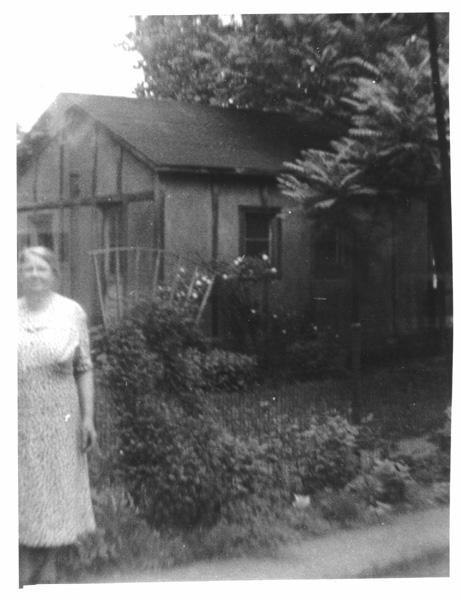
In my childhood memories, certain people shared the wonder of seeds. My grandmother Anna handed me a round pod from a tall hollyhock, opening it to display the way the seeds were all nestled in a ring, telling me that we needed to plant them in late summer to grow and flower the next year. I promptly tried to plant them under an Ailanthus tree, and learned that hollyhocks need sun.

When I was in elementary school, we students were given boxes of seed packets, and after being pumped up by classroom speeches, were sent home to sell them door-to-door, thus improving the world and gaining fabulous prizes. I can’t remember if it was a result of one of these campaigns, but my mother planted a package of Four O’Clocks near the SW corner of our house. The little things that looked like pebbles became a temporary shrub, “The Marvel of Peru”, that was covered in flowers by the time school began in fall.

My dad occasionally planted a row or two of peas, and the vines produced pods that we could pop open, eating the delicious raw peas. Maybe my father had hoped to grow real crops on our acre of suburban prairie? After all, our neighbors treated their acre like a miniature farm, with a vegetable garden, dwarf fruit trees, goats and grapevines. That was possible for two mature people – but our well could barely meet the household needs of a family with 5 kids. There was enough surplus water left for keeping saplings alive and growing a few vegetables, but no mini-farm for us.

I was not yet out of my teens when I married Philo, and discovered that my husband was a born gardener! Even when we were newlyweds, living in beat-up grad student housing, he planted sunflowers, radishes, peas, and marigolds in the tiny patch of land around the house. Another graduate wife gave me a few divisions of perennials – oxalis, chrysanthemums and iris, and our plant propagation pattern began.

We had space for medium-size vegetable gardens in each of our three Illinois yards, always with tomatoes, peppers, and of course peas in the vegetable garden, and with summer annuals like zinnias and marigolds in flowerbeds.

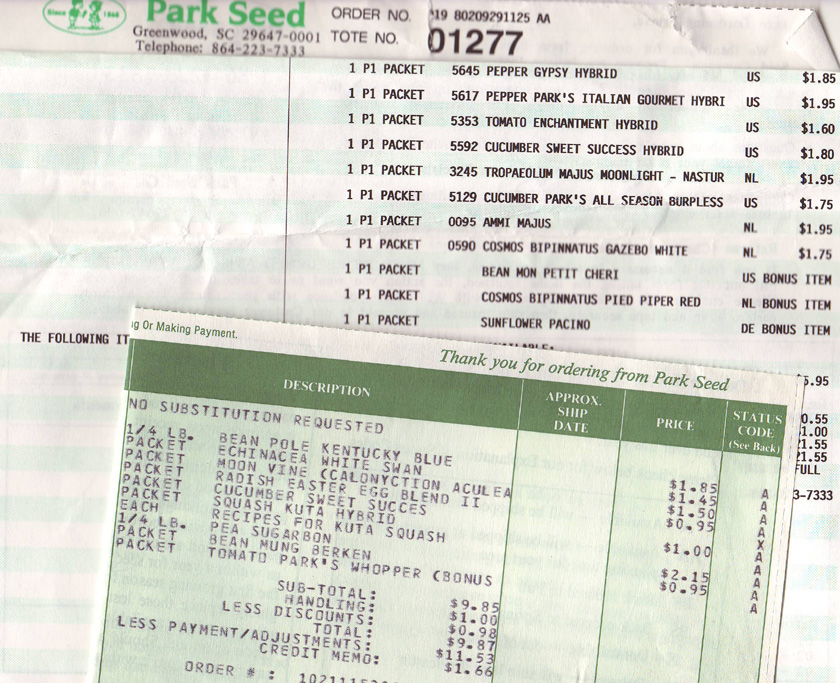
By the time we moved to our second house, the Sugar Snap Peas were introduced, just in time for the stirfry craze to sweep the country. We experimented with other interesting vegetables from the catalogs, like delicious Kuta squashes, the new Gypsy peppers, and the very odd Asparagus peas, and we began growing fresh herbs like basil and dill. Some things were planted directly but some were started inside.
When the catalogs came, we’d look them over for weeks, finally making our decisions. Since many favorite vegetables and flowers were available at local stores like Franks, we concentrated our mail orders on the ‘special’ seeds. At that second house, I still scattered cosmos and alyssum, marigolds and zinnias, but my heart belonged to iris, clematis, peonies, lilacs, phlox and other perennials that were shared by division, rather than seed.

When we moved to house # 3, there was a somewhat larger space for a vegetable garden, and there was basement space for seed starting.
Philo built a 4’ X 2’ wooden box, with 4-inch sides, and set it on a worktable so it was at waist level. He cut a section of ½ inch hardware cloth to fit the box exactly, then wound silicone-coated heating tape back and forth, so that all parts of the box would get even heat, making sure the end of the tape with the plug hung out of the box at a corner. He’d scrounged some old wooden window blinds, and took them apart, cutting and fitting them to make a grid, which divided the box into planting squares. This framework was filled with a light potting soil – not the store-bought kind, but a mixture that he’d stirred up like an alchemist in his wheelbarrow. Now it was time to plant the seeds, with the name of each variety written on the wooden wall of each square. Once the seedlings broke ground the lights were turned on. The light fixtures were also scrounged, the old fluorescent tubes replaced with grow lights, and the lights were hung on a frame made of PVC pipe. Philo designed the frame so it could be disassembled and stored.

With this system, Philo grew interesting, hard-to-find varieties of tomatoes and peppers, and I was able to start perennials from seed, like Blackberry lilies, columbine, white coneflowers, Lychnis coronaria alba and splashy hardy Hibiscus.


Those twelve years at house & garden # 3 were the high point of our seed era, ending in 1999 when we came to Texas. We still garden here, but it’s a different kind of gardening – at the last house, the vegetables had to be protected from the deer and grown in a 5' X 12' wire enclosure!
Now in house # 5 we have a small garden area, but with no basement or attic, where could we even set up the seed box? Luckily for us, the Sunshine Community Gardens here in Austin have a sale of plant starts and plant divisions every spring. The lines are long, but Philo has been able to try all sorts of tomatoes and peppers, including heirlooms.

I’ll answer a few of Carol’s questions:
Buy seeds? Yes, we still buy some seeds, but also buy a lot of starter plants. When I am in a nursery, a big box store, gift shops belonging to parks, or even in unlikely places like the dollar stores, I’ll run my eye over the seed racks. To a casual observer, my purchases might look like impulse buying, but I keep a sort of mental wishlist, so if I see the ones I want, I grab them, wherever they show up. That’s why I have a package of heirloom 'Cupani' Sweet peas ready to plant – they turned up at Red Barn and I grabbed them.

Seed Catalogs? I’m ashamed to admit this, but since moving to Texas in 1999, we’ve become such crummy mail order customers that no one even SENDS us any catalogs! I do browse the Park Seed site, but the Plant Delights site gets more hits from my computer.

Bulk seed store? One place we frequented was Pioneer Feed and Grain back in Illinois. It’s a cool old-fashioned place, with some seeds by the scoop, as well as seed potatoes and onion sets.

Save seeds? I save the seeds from many plants, like Moonvine, Blue Pea Vine and Hyacinth Bean. I buy basil seed, alyssum, and sometimes zinnias for cutting. There are always a few seed packages in a basket in the breakfast room.

Since we moved to house # 5 in this warmer climate, some of our annuals and perennials feel quite at home here, and they volunteer all over the place. Sometimes the 'Coral Nymph' salvias, Cardinal vines, Larkspurs, Verbena bonariensis, marigolds, Cooper lilies, Purple coneflowers, Balloon flowers, Cupheas, Sunflowers, ‘Katy’ Ruellia, Pavonia/Rock roses, and cilantro choose a different place from what I had originally planned. If that place is a better choice, they can stay. If I don’t approve, they’re weeded out or relocated.

As the garden evolves, it seems less necessary to plant seeds – and more important to recognize seedlings.