

 Posts
Posts


Back in 2004, I began writing what I originally thought was poetry, musings on how it felt to be a gardener from Illinois who’d been plunked down in the heart of Texas. I soon realized that these words weren't poetry - they were lyrics. Our son Ted took the verses about missing Lilac time up North, set them to music, and copyrighted our collaboration. “Texas In May” has been a favorite when performed for friends and family, and some day it may be recorded.
Ted’s example inspired me, and soon I had more than half-a-dozen songs under copyright. Together, they tell a story – a sort of musical play. Although the situation - that transplantation from Illinois to Austin - was my own experience, in the story the leading lady is quite a different person, who comes to Austin for very different reasons.
One of the songs is called “The Transplantable Rose”, also used as the name for this blog last June. I’m no singer, but it’s my song, now on YouTube, along with the previously recorded theme for the Divas of the Dirt. Friend Nick recorded the sound, and played the acoustic guitar for “The Transplantable Rose” and Philo made the video.
Station kaefka is a joint effort by Philo & me, [reachable when you double click on the YouTube screen] and 'age 40' refers to how many years we’ve been together. At station kaefka you’ll see links to other favorite videos, including Ted playing his concertina and videos by Ted’s wife, our darling Diane Marie, who is a professional musician in the Chicago area.
When I was nine years old my ambition was to be a writer and a singer – half-a-century later the folks at Google have given me that chance. Thank you.
About Me


- Annie in Austin
- Welcome! As "Annie in Austin" I blog about gardening in Austin, TX with occasional looks back at our former gardens in Illinois. My husband Philo & I also make videos - some use garden images as background for my original songs, some capture Austin events & sometimes we share videos of birds in our garden. Come talk about gardens, movies, music, genealogy and Austin at the Transplantable Rose and listen to my original songs on YouTube. For an overview read Three Gardens, Twenty Years. Unless noted, these words and photos are my copyrighted work.
Tuesday, December 19, 2006


Monday, December 11, 2006
Enjoying the Evergreens
 According to Google Earth, it’s less than 14 miles from Austin’s Zanthan Garden to my Austin garden, but if you’ve been looking at our garden blog posts, we seem to be at least half a climate zone apart. MSS’s tomatoes are chilled, but intact, having gone just below the freezing point a few times. Another Austin blog, Rantomat, reports nothing frozen at all in her garden. Pam at Digging does seem to have a few frosted plants.
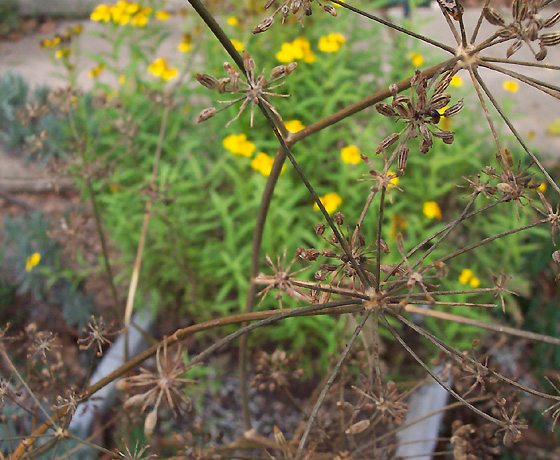 In this NW corner of Austin, my tomato and pepper plants were turned to mush at the first freeze on the first morning of December, with other plants, like the Pineapple Sage [Salvia elegans], not giving up until the temperatures went below 32ºF for a third time.
The fennel turned brown right away, but the Mexican Mint Marigold was barely brushed by the cold.
The Philippine Violet succumbed after the second freeze, first getting limp, now drying in place. 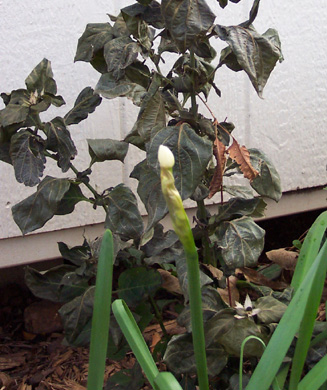 There’s a paperwhite narcissus in front of it, ready to open a bud. Maybe the plants in South Austin are alive because of the moderating effect of the Colorado River, which has been dammed to make Lake Austin and Town Lake.
Is that what makes the difference? Or is it just being closer to the heart of the city? Another factor may be variations in elevation – Zanthan lies somewhat less than 500 feet above sea level, while Pam/Digging is under 680, and the elevation for the patio at The Transplantable Rose is 978 feet.
[That’s only 22 feet under the official definition of ‘mountain’ in the sweet Hugh Grant movie, The Englishman Who Went Up a Hill But Came Down a Mountain.]
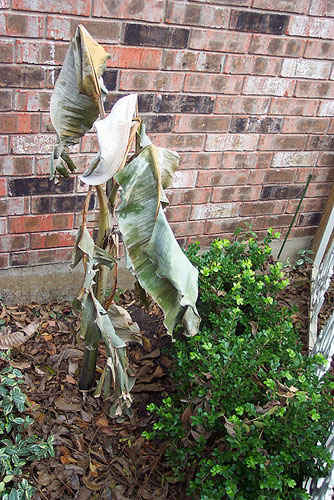 Unlike the gardenblogs of true northern gardeners like Kati, I have no beautiful frost photos to offer, because these cold snaps hit and run, leaving damage but not sticking around to look seasonal. We have few conifers, but our broadleaved types of evergreens take over now, and plants like the boring-in-summer boxwood are appreciated when the banana is hanging in tatters.
Flowers like pansies and dianthus are planted in fall, or soon after the holiday decorations come down, and are called winter annuals. 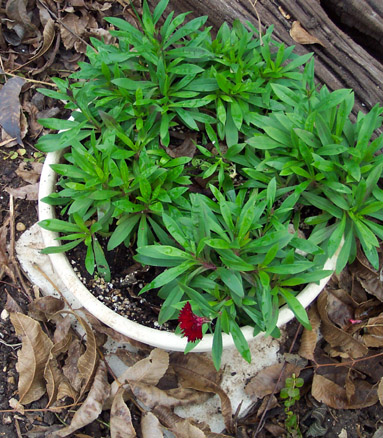
In Illinois we planted them in late April, but that’s when the heat starts here. Dianthus and pansies sail though most winters, unfurling buds on warmish days, enjoying the cooler weather just as the gardeners do.
That’s an Ilex at the tip of this post – a Burford Holly of some kind. This shrub was already here when we came, but has never been so full of berries before. I cut a few pieces from it, stripping the bottoms of the clipped twigs and pushing them into the hanging baskets so that the berried tops will hide what remains of winter-killed lantana plants. I’m hoping the twigs can stay green as long as possible, holding onto their berries, and maybe a few can root, if conditions are right.
 There’s a hedge of these hollies between my house and the one next door. I like my neighbors - they're lovely people - but they're not gardeners in any way. They prune to ensure that no shade falls across their pool, and they think that the outdoors should be as tidy as the indoors.
I had been eying my side of the hedge earlier in fall, observing the stem ends start to extend in new, lighter-colored growth and the berries begin to turn color. My plan was to make a real holly wreath for my door this Christmas. I was shocked to come home one day and find the Neat-Neighbors had used some kind of hedge clippers to form the holly hedge [and even the graceful variegated privet!] into ugly geometric boxes. If any of those holly cuttings take root, there may be another hedge of holly here some day, not along the lot line, but growing well inside my domain, and never touched by a power tool.
Saturday, December 02, 2006
Decisions Were Made
Living in a sub-tropical climate tempts one to grow a lot of marginal plants, so some Austin folk build frames across the back of their houses each autumn, covering the wood or plastic skeleton in heavy plastic using open house windows to add enough warm air to keep slightly tender plants alive. Luckily, Philo was uninterested in building a temporary greenhouse, forcing me to Decide.
We used a dolly to roll the yellow plumeria into the garage, where it now fills a corner with 7-feet tall by 4-feet wide branches. I started this plumeria from a stick in 2001, and at the beginning of each winter it has dropped its leaves and stayed dormant in the garage.
In spring of 2005, a kind NE Austin gardener named Jane gave me a cutting from one of her red plumerias. Once it was well-rooted and repotted, the new one began to grow, reaching 30 inches by late fall 2005, when it joined the bigger one in the garage. But just like my kids, this baby would not go to sleep, refusing to go dormant. Moved outside again in spring, it branched out, bloomed, and grew quickly to over 5-feet tall. This year, I’m trying an experiment, letting the Plumeria stay awake for the winter in the breakfast room.
 We should probably start referring to this space as the conservatory – the Meyer’s Lemon is also inside near the windows. Christopher from Hawaii suggested that we keep this lemon tree as a potted plant, and buy a new one for the ground. This idea made sense to my husband, and with 7 almost-ripe lemons on it along with a new batch of pea-sized fruit, I couldn’t bear to leave it outside!
 On the windowsill in the photo you can see the little Aloe, safe because Pam/Digging warned me it was tender. Last winter, a pink tropical Hibiscus spent the winter in the breakfast room but it wasn't happy, developing both mealybugs and aphids. I set this plant close to the back wall near a window, but won’t let that Hibiscus inside this winter. There was a good spot for the Hedychium coronaria [Hawaiian White Ginger] near the back fence, so a big chunk from the patio container went there, with lots of amendments, a good watering, and leaf mulch piled around the base. The 'Best of Friends' daylily from Pam was planted, too, but the rest of the garden had to be left to chance.
 On Thursday three clumps of Bengal Tiger cannas were in bloom, the non-blooming Brugmansia stood a foot taller than it had been in the spring, while the various Cupheas were blooming and still attracting bees and butterflies. A large Fennel plant also offered flowers to the butterflies.
I was still wearing shorts and sandals on Wednesday, as I finally got my act together, hoping the precautions were not really necessary. Over the last few years we’ve heard many frost or freeze warnings that never actually delivered the expected blow, but this time, the predictions were quite accurate. The Friday landscape showed the changes, with all the canna leaves a tobacco color, the top of the Brugmansia floppy, and both fennel and the cupheas shriveled and browned. I was actually glad to see the peppers and tomatoes wilted by the freeze, and the basil put out of its misery. Cleaning up a big mess is sometimes easier than fidgety maintenance!
We used a dolly to roll the yellow plumeria into the garage, where it now fills a corner with 7-feet tall by 4-feet wide branches.
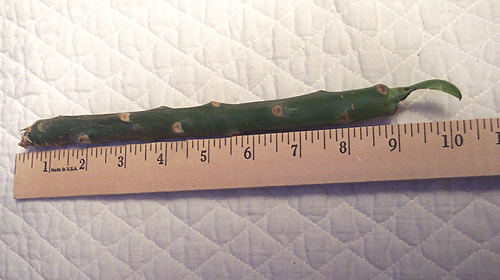 I started this plumeria from a stick in 2001, and at the beginning of each winter it has dropped its leaves and stayed dormant in the garage.
In spring of 2005, a kind NE Austin gardener named Jane gave me a cutting from one of her red plumerias. Once it was well-rooted and repotted, the new one began to grow, reaching 30 inches by late fall 2005, when it joined the bigger one in the garage. But just like my kids, this baby would not go to sleep, refusing to go dormant. Moved outside again in spring, it branched out, bloomed, and grew quickly to over 5-feet tall. This year, I’m trying an experiment, letting the Plumeria stay awake for the winter in the breakfast room.
We should probably start referring to this space as the conservatory – the Meyer’s Lemon is also inside near the windows. Christopher from Hawaii suggested that we keep this lemon tree as a potted plant, and buy a new one for the ground. This idea made sense to my husband, and with 7 almost-ripe lemons on it along with a new batch of pea-sized fruit, I couldn’t bear to leave it outside!On the windowsill in the photo you can see the little Aloe, safe because Pam/Digging warned me it was tender. Last winter, a pink tropical Hibiscus spent the winter in the breakfast room but it wasn't happy, developing both mealybugs and aphids. I set this plant close to the back wall near a window, but won’t let that Hibiscus inside this winter. There was a good spot for the Hedychium coronaria [Hawaiian White Ginger] near the back fence, so a big chunk from the patio container went there, with lots of amendments, a good watering, and leaf mulch piled around the base. The 'Best of Friends' daylily from Pam was planted, too, but the rest of the garden had to be left to chance.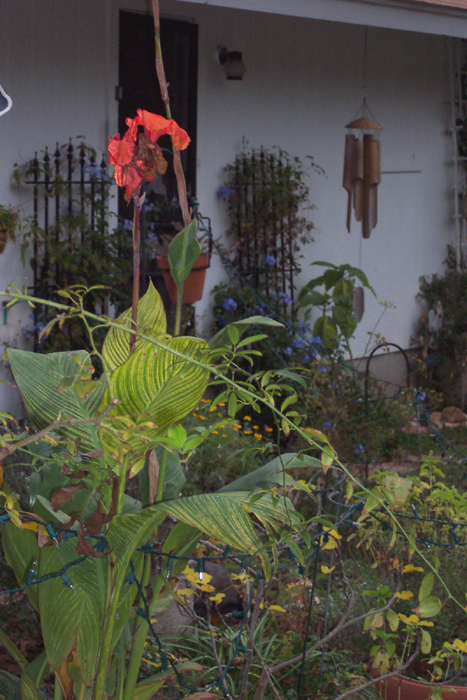 On Thursday three clumps of Bengal Tiger cannas were in bloom, the non-blooming Brugmansia stood a foot taller than it had been in the spring, while the various Cupheas were blooming and still attracting bees and butterflies. A large Fennel plant also offered flowers to the butterflies.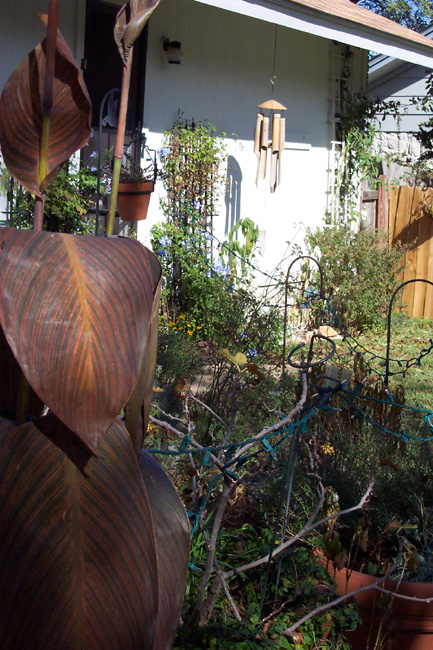
I was still wearing shorts and sandals on Wednesday, as I finally got my act together, hoping the precautions were not really necessary. Over the last few years we’ve heard many frost or freeze warnings that never actually delivered the expected blow, but this time, the predictions were quite accurate. The Friday landscape showed the changes, with all the canna leaves a tobacco color, the top of the Brugmansia floppy, and both fennel and the cupheas shriveled and browned. I was actually glad to see the peppers and tomatoes wilted by the freeze, and the basil put out of its misery. Cleaning up a big mess is sometimes easier than fidgety maintenance!
Now the Christmas tree is assembled, with lights in place, ready for decorating. We’re enjoying our happy kitchen-conservatory, and thanks to the big freeze, I’m moving forward again.
Tuesday, November 28, 2006
In Transition
We only have a few Thanksgiving decorations to put away, but they were still lying around Sunday when we started to put up icicle lights on the veranda. This time of year was hectic in the North, too, but it seems even more chaotic down here, where the garden never sleeps and the ground doesn’t freeze.
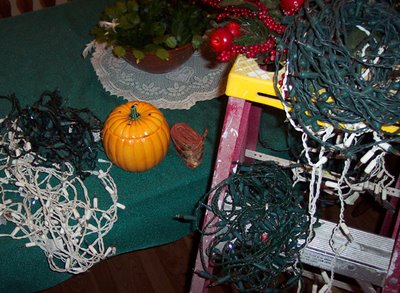
Many things have been started – few things have been finished – most things are stuck somewhere in the middle. At the beginning of this year the word I chose as my theme for 2006 was, “Decide” – and now in November it’s time to drag this word out again and repeat it over and over, hoping it can jolt me out of my mental inertia.
It’s been so warm that I didn’t bring the two Plumeria trees inside yet, and still haven’t figured out where I can fit them. After 7 months in the garden, both are in larger pots with much longer branches, so the corner of the garage is going to be really tight. The Hawaiian White Ginger needs to go in the ground, but where? The evergreen Hibiscus used to fit in the kitchen near the window, but it’s doubled in size. Should I prune it severely? Will that kill it? Can the Aloe vera stay out or is it tender? The Meyer’s Lemon is still in the pot by the door, and will probably come in and out for this winter. I’m still not sure where I want to put the daylily from Pam. There are a few peppers left hanging in the vegetable garden, in hopes they’ll be a little bigger by the time the cold cuts them down.
The weather has been pleasant and dry and the leaves are falling – so I'd better water all the containers and whatever’s been recently planted & transplanted. We want to put the Christmas tree up this week, so I'll start to move the furniture from that corner. I need to do some Christmas shopping, but I don't have a car today. Maybe I should write a few cards… but first I’ll answer email. I haven't posted in a week, but first I'll read a few garden blogs. I'll make up my mind after I eat the last bowl of turkey soup.
Then at 3 AM Monday I woke up to the sound of rain hitting the roof, maybe a third of an inch, bringing down another batch of leaves. The prediction now is for possible drizzle, with a few more warm days – then a freeze on Thursday and Friday. So my dithering must end and it’s time to Decide.
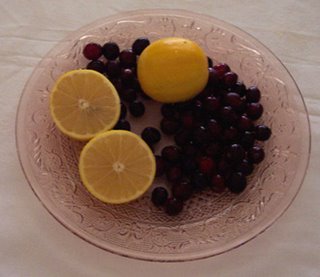 For decades of Thanksgiving feasts and Christmas dinners in Illinois, my mom has made a raw cranberry relish, and we use her recipe here in Texas. You’ve probably tasted it or maybe you make it yourself, with a bag of raw cranberries, a whole orange and a little sugar, chopped fine in a food processor or in batches in a blender. The Meyer's Lemon tree has produced some ripe fruit, with half-a-dozen lemons still to come. This year we made our relish with 2 bags of raw cranberries, 2 Meyer's lemons and one whole Satsuma orange, adding just barely enough raw sugar.
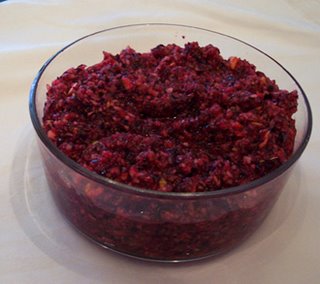 We were amazed at the sparkle and flavor the lemons added to this old favorite.
You see? I couldn’t even decide how to write this post! Should I talk about the relish recipe or whine and ramble about indecision at the end of November?
Both.
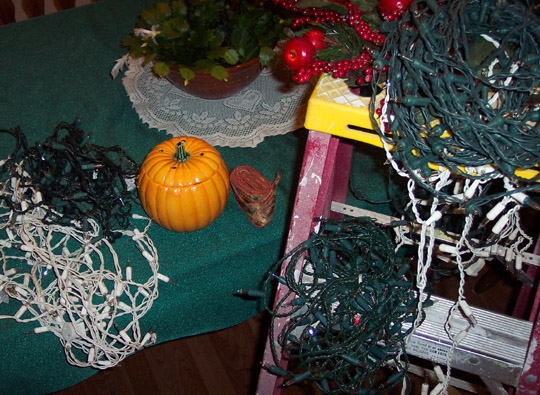
Many things have been started – few things have been finished – most things are stuck somewhere in the middle. At the beginning of this year the word I chose as my theme for 2006 was, “Decide” – and now in November it’s time to drag this word out again and repeat it over and over, hoping it can jolt me out of my mental inertia.
It’s been so warm that I didn’t bring the two Plumeria trees inside yet, and still haven’t figured out where I can fit them. After 7 months in the garden, both are in larger pots with much longer branches, so the corner of the garage is going to be really tight. The Hawaiian White Ginger needs to go in the ground, but where? The evergreen Hibiscus used to fit in the kitchen near the window, but it’s doubled in size. Should I prune it severely? Will that kill it? Can the Aloe vera stay out or is it tender? The Meyer’s Lemon is still in the pot by the door, and will probably come in and out for this winter. I’m still not sure where I want to put the daylily from Pam. There are a few peppers left hanging in the vegetable garden, in hopes they’ll be a little bigger by the time the cold cuts them down.
The weather has been pleasant and dry and the leaves are falling – so I'd better water all the containers and whatever’s been recently planted & transplanted. We want to put the Christmas tree up this week, so I'll start to move the furniture from that corner. I need to do some Christmas shopping, but I don't have a car today. Maybe I should write a few cards… but first I’ll answer email. I haven't posted in a week, but first I'll read a few garden blogs. I'll make up my mind after I eat the last bowl of turkey soup.
Then at 3 AM Monday I woke up to the sound of rain hitting the roof, maybe a third of an inch, bringing down another batch of leaves. The prediction now is for possible drizzle, with a few more warm days – then a freeze on Thursday and Friday. So my dithering must end and it’s time to Decide.
 For decades of Thanksgiving feasts and Christmas dinners in Illinois, my mom has made a raw cranberry relish, and we use her recipe here in Texas. You’ve probably tasted it or maybe you make it yourself, with a bag of raw cranberries, a whole orange and a little sugar, chopped fine in a food processor or in batches in a blender. The Meyer's Lemon tree has produced some ripe fruit, with half-a-dozen lemons still to come. This year we made our relish with 2 bags of raw cranberries, 2 Meyer's lemons and one whole Satsuma orange, adding just barely enough raw sugar.
 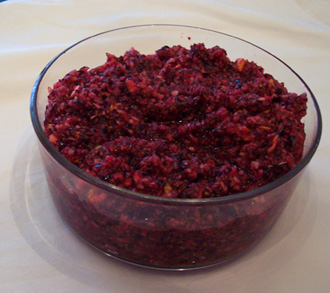 We were amazed at the sparkle and flavor the lemons added to this old favorite.
 You see? I couldn’t even decide how to write this post! Should I talk about the relish recipe or whine and ramble about indecision at the end of November?
Both.
Subscribe to:
Posts (Atom)